
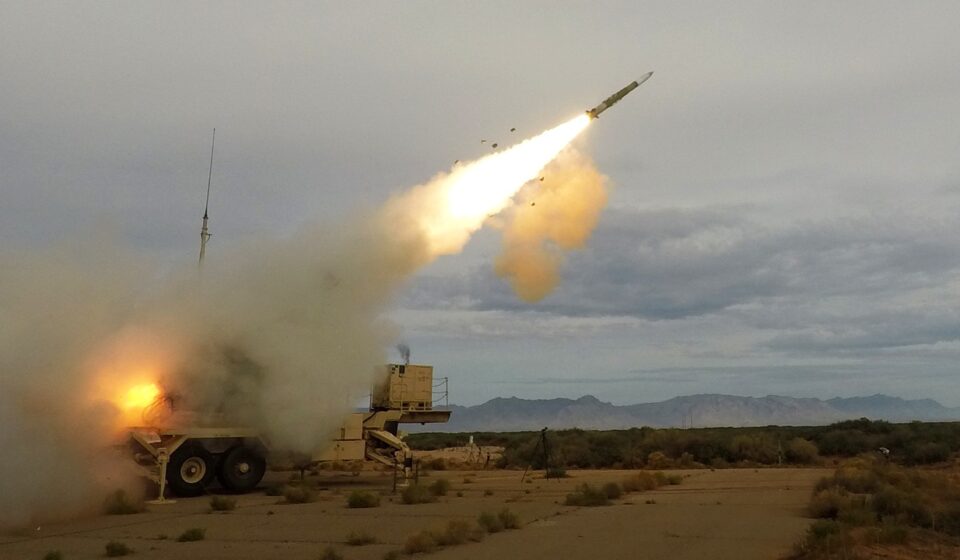


A PAC-3 interceptor missile is fired during a test at the White Sands Missile Range, New Mexico, in July 2018. The US has faced a severe shortfall of PAC-3 (Patriot) missiles. (White Sands Missile Range/John Drew Hamilton)
Why Can’t America Make More Interceptor Missiles?
The supply chain constraints affecting US missile production are structural in nature; they cannot be solved merely by throwing money at them.
One of the sharpest conflicts stemming from America’s wars in the Middle East is the rapid depletion of its anti-air interceptor missile inventory. Months of operations in the Middle East during the Trump administration—first Operation Rough Rider against the Houthi rebels in Yemen, then the far more expansive Operation Epic Fury against Iran, alongside consistent support for Israeli air defenses in the post-October 7 period—have consumed advanced interceptor missiles at a pace far faster than America’s existing defense industrial base can replace them.
Although most Americans do not worry about missile production rates, the problem is non-trivial. In fact, it is serious enough that the United States’ depleted missile inventories are now influencing broader strategic planning and force-posture decisions, particularly in Asia.
Industrial Bottlenecks to Blame for Munitions Shortfall
For obvious reasons, the Department of Defense does not release data on its missile attrition rate, nor the depth of its existing magazines. Still, it is possible to put together a rough picture of the missile situation based on reports of missile use in the Middle East and knowledge of existing production rates by US defense contractors.
SM-2 and SM-6: From this, it emerges that the missiles facing the most acute replenishment crisis are likely the SM-6 and SM-2, the Navy’s workhorse interceptors. These missiles defend aircraft carriers, destroyers, amphibious groups, and critical naval assets. Throughout the recent wars, US destroyers in the Red Sea and Persian Gulf have repeatedly fired large salvos against ballistic missiles, cruise missiles, and attack drones. The burn rate is not sustainable; reports indicate that hundreds of missiles have been expended in Operation Epic Fury alone. On the flip side, RTX (Raytheon), the prime contractor for the SM-6 missile, only makes around 125 to 200 of the missiles per year. In other words, the United States has consumed several years of production capacity in just a few months of combat operations against Iran, for a campaign with limited strategic benefit.
PAC-3 (Patriot) Missiles: PAC-3 MSE inventories, chiefly the domain of the US Army, are also under extreme pressure. The PAC-3—more commonly known as the “Patriot missile” after the MIM-104 Patriot air defense system, its primary launch platform—is America’s premier interceptor for ballistic missiles and advanced air threats. But Lockheed Martin is currently producing only 550 to 650 Patriots per year, and these are intended for US forces everywhere in the globe, not merely the Middle East. The Ukraine war had already forced the United States to reroute PAC-3 exports from NATO allies to Ukraine during the Biden administration; the current crisis in the Middle East has made matters far worse. The shortfall in missiles has led to massive new investments in PAC-3 production, as well as creative solutions like outsourcing it to other countries; Lockheed Martin has licensed missile production to Japan to export back to the United States.
AIM-120 AMRAAM: The AIM-120 AMRAAM, a general-purpose air-to-air missile, is also under strain. The problem is that the AMRAAM missile is used by nearly everyone; it supports US Air Force and US Navy fighter jets, allied air forces in NATO and the Pacific, Ukrainian air defenses, and NASAMS anti-air batteries. All of these users are drawing from the same production line; AMRAAM manufacturer RTX makes roughly 1,200 of the missiles per year, although it plans to double capacity by 2028 and has invested accordingly in new production lines. To further ease shortages, the Pentagon is reportedly exploring acquiring older AMRAAM inventories from partner nations.
So why can’t the US just build more of these systems? The primary constraint is not money, but industrial capacity; a handful of inputs are difficult to ramp up production for, creating bottlenecks for the rest of the missile supply chain.
- Solid Rocket Motors: In spite of their differing designs, nearly every advanced interceptor missile depends on the same highly consolidated rocket-motor section, which is difficult to build and requires human expertise.
- Skilled Labor: Production of many missile components requires specialized technicians who need years of training in order to complete their jobs. Nor is expertise the only constraint; many technicians in sensitive jobs must complete thorough security vetting to ensure they will not share production secrets with US adversaries, taxing the limited resources of government investigators.
- Precision Tooling: Many components depend in turn on advanced machines, which are costly to build and subject to their own supply chain constraints. Though production of these is ramping up, many take time and cannot simply expand overnight.
The bottom line is that the industrial base was optimized for gradual peacetime procurement, not a sudden wartime surge.
The Pentagon’s Solution to the Munitions Crisis: More Money
Washington is responding aggressively, in the only way it knows how.
Recent defense budgets have dramatically increased procurement funding. Funding for SM missiles jumped from $1.26 billion to $8.5 billion from Fiscal Year 2026 (FY26) to FY27. The goal is to rebuild inventories while expanding future production capacity.
Unfortunately, missiles cannot be replenished quickly. Even with all the money in the world, the SM-6 won’t be restored to pre-2025 magazine depth until 2028 or 2029; the PAC-3 until mid-2029; the THAAD until late 2029; the Tomahawk, a cruise missile also used extensively in Iran, around 2030. Many advanced interceptors require roughly two years from component production to final delivery.
The strategic consequences of this lag are significant. The Pentagon’s plans for the Pacific rely heavily on SM-6 interceptors, Patriots, and THAAD systems. These weapons would be absolutely critical in a conflict involving China. Every interceptor fired in the Middle East means one interceptor unavailable for the Pacific. So using multi-million-dollar interceptors to defeat cheap drones in the Middle East is a strategic loss.
About the Author: Harrison Kass
Harrison Kass is a writer and attorney focused on national security, technology, and political culture. His work has appeared in Tablet, City Journal, The Hill, The Spectator, and The Cipher Brief. He holds a JD from the University of Oregon and a master’s in Global & Joint Program Studies from NYU. More at harrisonkass.com.
The post Why Can’t America Make More Interceptor Missiles? appeared first on The National Interest.