
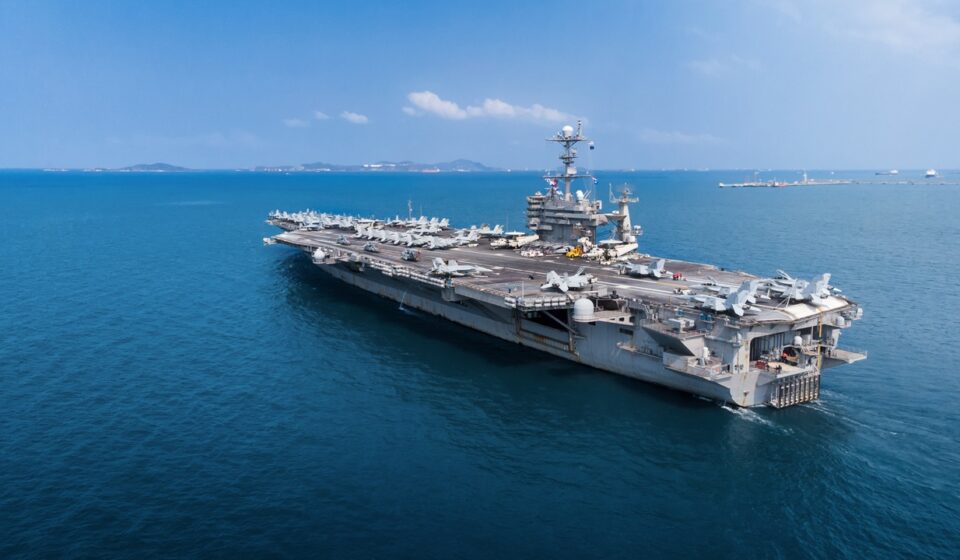


A US Navy aircraft carrier at sea. (Shutterstock/GreenOak)
Where Are America’s Aircraft Carriers Now?
Although the US Navy has 11 nuclear-powered aircraft carriers in active service, only around half are deployed at any given time—with the rest in port or undergoing maintenance.
The United States Navy operates the largest fleet of nuclear-powered supercarriers in the world, though China is trying to catch up.
How Many Aircraft Carriers Does the US Have?
The Navy maintains 11 nuclear-powered aircraft carriers, including 10 of the Nimitz-class and one of the Gerald R. Ford-class. With 11 carriers in active service, the US Navy has more than the navies of China, the UK, India, France, Italy, and Spain—combined!
In the coming decades, the older Nimitz-class carriers will be replaced by the newer Ford class on a one-for-one basis. The next such replacement is slated for spring 2027, when the USS Nimitz (CVN-68) will be retired from service as the USS John F. Kennedy (CVN-79) is commissioned.
The US Code, specifically 10 USC § 5062, mandates that the US Navy maintain at least 11 operational aircraft carriers in its fleet. Yet the status and actual “availability” of the carriers are not always as cut-and-dry as they seem. Rarely are more than five or six deployed at a time, with the rest undergoing short-term or long-term maintenance in port.
Here is the current status of the US Navy’s aircraft carriers:
USS Nimitz (CVN-68)
- Commissioned: May 3, 1975
- Current Status: Deployed (US East Coast)

The United States Navy’s oldest active nuclear-powered supercarrier is expected to arrive at Naval Station Norfolk before the end of the month. The USS Nimitz (CVN-68), which also became the longest-serving aircraft carrier in US Navy history in May, is now operating in US waters and arrived at Naval Station Mayport, Florida, last week.
“We were greeted by Rear Admiral Sardiello, commander of US Naval Forces Southern Command & US 4th Fleet, who came aboard to congratulate the crew on the Nimitz Carrier Strike Group’s accomplishments during Southern Seas 2026,” the official social media account of USS Nimitz announced in a post on Facebook.
The US Navy also announced that CVN-68 and her strike group “successfully completed their highly anticipated deployment to the US Southern Command area of responsibility as part of US Naval Forces Southern Command/US 4th Fleet’s Southern Seas 2026.”
USS Nimitz, which is in the final stages of a homeport swap underway, departed from Naval Base Kitsap, Washington, in March and sailed around South America, transiting the Strait of Magellan in April. The lead vessel of the US Navy’s Nimitz-class nuclear-powered supercarriers took part in a goodwill/farewell tour.
CVN-68 was dispatched to the United States Navy’s Southern Seas 2026 deployment, which included multiple port visits along the way. The warship participated in joint exercises with the maritime forces of US partners throughout Latin America. It hosted multiple foreign dignitaries and government officials, including the presidents of Argentina, Chile and Uruguay.
“The USS Nimitz’ Southern Seas 2026 deployment provided a unique opportunity to enhance interoperability and build proficiency with our partner nations across the maritime domain,” explained Rear Adm. Carlos Sardiello, commander, US Naval Forces Southern Command/US 4th Fleet. “Deployments of this magnitude demonstrate our unwavering commitment to a secure and stable Western Hemisphere. This historic mission is a shining example of our dedication to strengthening regional partnerships, building mutual trust, and countering shared threats together.”
USS Nimitz was commissioned 51 years ago in May 1976 and is scheduled to be decommissioned next March. The homeport swap is expected to be the Nimitz‘ final time underway at sea before being recycled, ending her historic career.
Background: Named after Fleet Admiral Chester W. Nimitz, the United States Navy’s last five-star admiral, the keel of the USS Nimitz (CVN-68) was laid on June 22, 1968. The largest warship at the time of her commissioning on May 3, 1975, she has served in the Navy for more than 50 years.
As a floating airbase, USS Nimitz is typically embarked with approximately 60 aircraft, including a variety of fixed-wing and rotary-wing aircraft with up to 90 of various types. The aircraft now include F/A-18E/F Super Hornets, F/A-18 Hornets, E-2 Hawkeyes, EA-6B Prowlers, and MH-60 Seahawk helicopters. The carriers could also deploy the S-3B Viking, before it was phased out and replaced by the F/A-18E/F Super Hornet.
USS Dwight D. Eisenhower (CVN-69)
- Commissioned: October 18, 1977
- Current Status: In Port (Norfolk, Virginia)

USS Dwight D. Eisenhower (CVN-69) continues to prepare for her next deployment. The second oldest Nimitz-class supercarrier completed her sea trials in April.
On June 15, a change of command ceremony was held aboard the supercarrier, as Rear Adm. P. Scott Miller relieved Rear Adm. Dusty Rhodes as the commander of Carrier Strike Group 2 (CSG-2) after serving in the role since May of last year. Rhodes oversaw the completion of CVN-69’s fiscal year 2025 (FY25) Planned Incremental Availability (PIA).
“Serving as Commander, Carrier Strike Group Two has been an extraordinary privilege,” said Rhodes. “Throughout my time with this exceptional team, I witnessed firsthand the resilience and unwavering commitment of our Sailors, civilians, and our families as we navigated the challenges of a lengthy shipyard period and successfully returned to operational readiness. As the strike group enters a demanding workup cycle in preparation for deployment in early 2027, I am confident in their ability to meet every challenge and continue the legacy of excellence. It has been a true honor to serve alongside this remarkable team.”
Background: The USS Dwight D. Eisenhower (CVN-69) is the second-oldest nuclear-powered flattop in service in the world today. However, like the USS Nimitz, her days are also numbered; she is currently scheduled to be replaced around 2029, when the new Gerald R. Ford-class supercarrier USS Enterprise (CVN-80) enters service. The current timeline is already later than the originally planned 2028 retirement date, due to delays in the Ford-class program.
Named in honor of the 34th president of the United States and General of the Army, Congress authorized construction of the carrier in 1970, which it commissioned seven years later.
Over its lengthy service history, the USS Dwight D. Eisenhower has been deployed to a litany of combat operations. The ship’s first deployment was during the ill-fated Operation Eagle Claw during the 1980 Iran hostage crisis. A decade later, one of the carrier’s most notable deployments took place during Iraq’s invasion of Kuwait in 1990. CVN-69 made history when she became the second nuclear-powered carrier ever to pass through the Suez Canal.
The USS Dwight D. Eisenhower hosts Carrier Air Wing Three, sometimes known as the “Battle Axe.” Its air wing has a total of 90 aircraft, including F/A-18 Super Hornets, EA-18G Growlers, E-2 Hawkeyes, C-2 Greyhounds, and MH-60 Seahawk helicopters.
USS Carl Vinson (CVN-70)
- Commissioned: March 13, 1982
- Current Status: In Port (San Diego, California)

USS Carl Vinson (CVN-70), the third Nimitz-class aircraft carrier, returned from a nine-month deployment last August, and likely won’t head out again until the end of 2026 or more likely in early 2027.
However, in early June, the San Diego-based carrier was honored for last year’s deployment, receiving the United States Navy’s Battle Effectiveness Award (Battle “E”) for the warship’s 2024-2025 deployment, the service confirmed.
During the past deployment, CVN-70 operated in the US 3rd, 5th, and 7th Fleet areas of operations, and the sailors of the Carl Vinson Carrier Strike Group conducted more than 10,000 sorties and 23,000 flight hours. The supercarrier also sailed over 275,000 combined nautical miles.
“The Carl Vinson team displayed unrelenting perseverance and superior performance as they successfully carried out sustained operations at sea throughout 2025,” said Capt. Joshua Wenker, commanding officer of the Carl Vinson. “Our Sailors worked together to successfully execute a wide range of missions while operating in the Western Pacific and the Middle East, once again setting the standard for courage and steadfastness. I could not be more proud of my team, and their achievements continue to add to the storied history and legacy that has made this ship America’s Favorite Carrier!”
Background: The third Nimitz-class nuclear-powered supercarrier, USS Carl Vinson (CVN-70), is named for the late Carl Vinson (D-Georgia), who represented the Peach State in the House of Representatives for a remarkable 51 years—and earned the nicknames “Swamp Fox” and “the Admiral” for his support of naval affairs. Although he never served in the Navy, Vinson served as chairman of the House Naval Affairs Committee in 1931 and played a pivotal role in guiding the US Navy through World War II and the early Cold War. He was a strong advocate of the Two-Ocean Navy Act, which dramatically increased the naval budget by 70 percent.
The USS Carl Vinson was launched in 1980 and officially entered service in 1983. During more than four decades in service, the carrier has earned multiple Battle Effectiveness Awards (Battle “E”) for her role in naval operations in 1990, 1996, 1998, 2001, 2004, 2011, 2015, and 2018. USS Carl Vinson has been awarded additional honors, including the Navy Unit Commendation, the Meritorious Unit Commendation, and the Sea Service Deployment Ribbon. Following the successful Navy SEAL raid that led to the killing of Osama bin Laden, the terrorist leader’s body was buried at sea in 2011 from the deck of the warship.
During her most recent deployment, CVN-70 took part in Exercise Pacific Steller 2025 with the Maritime Nationale (French Navy) and the Japanese Maritime Self-Defense Force (JMSDF) in the Philippine Sea, and in the subsequent Exercise Freedom Shield 25, carried out joint aerial drills with the United States Air Force and the Republic of Korea Air Force (RoKAF).
In March, USS Carl Vinson was ordered to the Middle East and arrived in April, when it carried out strikes on the Houthi militants in Yemen as part of Operation Rough Rider. During the deployment, the carrier and its strike group sailed more than 275,000 nautical miles, and its air wing conducted in excess of 10,000 sorties.
The Carl Vinson is supported by Carrier Air Wing Two, consisting of nine air squadrons, or around 90 aircraft. CVW-2 flies F/A-18 Super Hornets, EA-18G Growlers, E-2 Hawkeyes, and MH-60 Seahawk helicopters—as well as the V-22 Osprey tiltrotor aircraft and the F-35C Lightning II, the carrier version of the F-35.
USS Theodore Roosevelt (CVN-71)
- Commissioned: October 25, 1986
- Current Status: Deployed (Eastern Pacific)

CVN-71, the flagship of Carrier Strike Group 9, left her homeport of San Diego last week for the Pacific. Eagle-eyed observers spotted the warship leaving port on June 15.
The warship is now underway in the eastern Pacific and “conducting exercises to bolster strike group readiness and capability in the US 3rd Fleet area of operations,” the US Navy announced.
CVN-71 will lead the US participation in the upcoming 2026 Rim of the Pacific exercises, which will run from June 24 to July 31. Currently, more than 30 nations, with approximately 40 surface ships, five submarines, and 140 aircraft, are expected to take part in what is now the world’s largest international maritime warfare exercise.
Background: The fourth Nimitz-class nuclear-powered aircraft carrier, CVN-71 is named for Theodore “Teddy” Roosevelt, the 26th president.
USS Theodore Roosevelt (CVN-71) was the first US Navy aircraft carrier to be assembled in large sections, or modules. Much like building a model, innovative construction techniques have been used on every aircraft carrier since. The use of modules also sped her construction; she was launched in October 1984 and commissioned two years later, in October 1986. The carrier began her maiden deployment in late December 1988 with Carrier Air Wing Eight (CVW-8) embarked.
CVN-71 is now one of the most decorated warships of the post-Cold War era. Her awards include a Joint Meritorious Unit Award, three Navy Unit Commendations, five Battle Efficiency Awards (Battle “E”), two National Defense Service Medals, two Security Excellence Awards, and a Global War on Terrorism Expeditionary Medal, among others. The warship was also awarded a NATO Medal, as well as Kuwait Liberation Medals from both Kuwait and Saudi Arabia.
USS Theodore Roosevelt is home to Carrier Air Wing Eleven. Like its sister air wings, CVW-11 has a strength of roughly 90 aircraft, including F/A-18E/F Super Hornets, EA-18G Growlers, E-2C Hawkeyes, C-2A Greyhounds and MH-60R/S Seahawk helicopters.
USS Abraham Lincoln (CVN-72)
- Commissioned: November 11, 1989
- Current Status: Deployed (Arabian Sea); participating in Iran operations

The United States Navy’s fifth Nimitz-class supercarrier remains deployed to the United States Central Command (CENTCOM) area of responsibility, where it has been supporting the US blockade of the Strait of Hormuz. The USS Abraham Lincoln (CVN-72) could remain in the region at least until a peace deal is signed between the United States and Iran, and possibly longer to ensure that an agreement over Tehran’s nuclear program can be finalized.
However, the bigger news this month for CVN-72 is that it is not clear where it is returning to once its time in the Middle East is completed. The carrier could see a homeport shift from Naval Air Station North Island, San Diego, to Naval Base Kitsap in Bremerton, Washington—making up for the absence of the Nimitz.
US Navy Admiral Daryl Caudle announced during a visit to the Naval Base Kitsap earlier this month, adding that the USS Ronald Reagan (CVN-76) will also remain in the Pacific Northwest.
Naval Base Kitsap is the US Navy’s third-largest fleet concentration area in the United States, and according to the service, it is the most complex. It is home to more than 70 tenant commands, including Commander, Navy Region Northwest; Commander, Submarine Group 9; Commander, Carrier Strike Group 3; Naval Facilities Engineering Command Northwest; Naval Undersea Warfare Center Keyport; and Puget Sound Naval Shipyard and Intermediate Maintenance Facility.
Background: The second US Navy vessel named after the 16th president—after the Cold War-era George Washington-class ballistic missile submarine—CVN-72 was commissioned in November 1989. Over the past three and a half decades in service, USS Abraham Lincoln has carried out multiple humanitarian missions in the Persian Gulf and Pacific region. It has taken part in multiple combat operations.
USS Abraham Lincoln arrived in San Diego in December 2024, ending her previous deployment and participating in numerous exercises, including Northern Edge 2025. CVN-72 was initially deployed in August 2024 to the Indo-Pacific region, but was ordered to the Red Sea in August to relieve USS Theodore Roosevelt, as part of the service’s ongoing carrier rotation in the Middle East.
In late 2024, while operating as part of CENTCOM’s 5th Fleet, USS Abraham Lincoln conducted air strikes on the Iran-backed Houthi militants in Yemen. That included the first-ever combat sortie of a Lockheed Martin F-35C Lightning II, the carrier-based variant of the Joint Strike Fighter. In November, F-35C aircraft, assigned to Marine Fighter Attack Squadron 314 (VMFA-314), “conducted multiple strikes on Houthi weapons storage facilities within Houthi-controlled territories in Yemen,” U.S. Naval Forces Central Command, US Fifth Fleet, explained.
The USS Abraham Lincoln is host to Carrier Air Wing Nine. CVW-9 is divided into eight squadrons; like the Carl Vinson, it operates roughly 90 F-35C Lightning II, F/A-18 Super Hornet, EA-18G Growler, E-2 Hawkeye, V-22 Osprey, and MH-60 Seahawk aircraft.
USS George Washington (CVN-73)
- Commissioned: July 4, 1992
- Current Status: Deployed (Philippine Sea)

The US Navy’s only forward-deployed aircraft carrier, the USS George Washington (CVN-73), departed from her homeport of Yokosuka, Japan, at the end of last month, beginning her 2026 patrol.
CVN-73 arrived in Guam on Tuesday, the first port visit during this year’s deployment.
“Guam remains a critical nexus for the Navy’s carrier strike groups,” said U.S. Navy Capt. Nicholas DeLeo, commanding officer of George Washington. “These Sailors have been working very hard, and I’m excited they have the opportunity to recharge here in Guam before we return to sea, ready to support our mission here in the Indo-Pacific.”
USS John C. Stennis (CVN-74)
- Commissioned: December 9, 1995
- Current Status: Undergoing RCOH (Newport News, Virginia)

CVN-74 is likely to spend much, if not all, of 2026 docked in port at Newport News, Virginia. USS John C. Stennis began her midlife Refueling and Complex Overhaul (RCOH) in 2021 and was originally on track to see the work completed by August 2025. However, in August 2024, it was announced that the warship wouldn’t return to service on schedule and that the carrier’s RCOH maintenance period would take longer than expected—about five and a half years in total, an extension of about 14 months from its planned schedule.
Work was impacted by the COVID-19 pandemic and unexpected damage, resulting in delays. The current timeline calls for the carrier to return to service in October 2026.
The upgrades may be worth the wait. As with all ships coming out of RCOH, the Stennis will be better than new once it emerges. In addition to a repainted hull and upgrades to the propeller shaft and other components, conditions on the ship will be improved for the crew, and she will be ready to operate with the fifth-generation Lockheed Martin F-35 Lighting II.
Background: The seventh Nimitz-class supercarrier was named for longtime Democratic Sen. John C. Stennis of Mississippi. The lawmaker, who served as the chairman of the Senate Armed Services Committee from 1969 until 1981, was seen as an odd choice for such an honor—yet it still gained the approval of then-President Ronald Reagan in 1988.
In contrast to some of the US Navy’s other aircraft carriers, the Stennis has had a relatively quiet service life. Notable exceptions came in 2007, when the ship served a tour in the Persian Gulf, and in 2012, when it helped to rescue the crew of an Iranian-flagged vessel hijacked by pirates in the Gulf of Oman.
For most of the 21st century, the Stennis played host to Carrier Air Wing Nine (CVW-9). However, CVW-9 was ultimately transferred to the USS Abraham Lincoln in May 2020, ahead of the Stennis’ RCOH period.
USS Harry S. Truman (CVN-75)
- Commissioned: July 25, 1998
- Current Status: In Port (Norfolk, Virginia); preparing for RCOH

The eighth Nimitz-class supercarrier is preparing for its scheduled extended mid-life refueling and complex overhaul (RCOH), a massive multi-year maintenance process that will take place at HII’s Newport News Shipbuilding in Virginia.
It is now clear that the US Navy has learned hard lessons from the RCOH of USS George Washington, which lasted nearly six years. That took a serious toll on the crew, with nine sailors committing suicide. Instead of relying on the majority of sailors taking part in the refit, the US Navy will turn to commercial contractors to perform more of the duties, allowing sailors to use the time the ship is out of service to instead focus on training and operational readiness.
“This shift is about putting our Sailors’ time and talents where they matter most,” Vice Adm. Scott Gray, who heads Navy quality of service CFT, said in a US Navy media release. “By contracting out routine tasks like transportation and preservation, we free our crew from traditional shipyard duties, empowering them to focus on their in-rate training and core warfighting capabilities.”
USS Harry S. Truman completed her last scheduled deployment on June 1, 2025, after spending eight months at sea operating in the US 5th and 6th Fleet areas of operations, including combat ops in the Red Sea against the Iranian-backed Houthi militants.
Background: The USS Harry S. Truman was named for the 33rd president of the United States—and the only president from Missouri—after the strenuous efforts of Ike Skelton, a Missourian member of the House of Representatives from 1977 to 2011.
CVN-75’s most recent deployment was not without incident. In February, the 100,000-ton warship collided with a 53,000-ton Panamanian-flagged cargo ship while operating in the Mediterranean Sea near Port Said, Egypt. The impact with the merchant vessel Besiktas-M damaged a sponson on the starboard side near one of the aircraft elevators, and it tore through the exterior bulkheads of two storage rooms as well as a maintenance space. The damaged area was covered by a banner when she was pierside during President Donald Trump’s speech in Norfolk, Virginia, to commemorate the 250th anniversary of the founding of the Continental Navy.
The Navy confirmed the damage won’t be addressed until CVN-75 begins her RCOH next year, after the Stennis’ RCOH concludes. The process is expected to sideline the carrier for three to four years.
Besides the damage taken during the collision, CVN-75 also returned from her extended deployment with three fewer fighters from her air wing.
One of the carrier’s F/A-18 Super Hornets was shot down in a friendly fire incident in December 2024, mistakenly identified as a hostile missile and fired upon by the Ticonderoga-class guided-missile cruiser USS Gettysburg (CG-64), one of the warships in the Truman carrier strike group (CSG). Fortunately, the pilots were able to eject safely and were quickly rescued.
In April and May, two other Super Hornets were lost while the carrier was operating in the Red Sea. The first of those two aircraft fell off the supercarrier while being towed to the hangar, and reportedly occurred as USS Harry S. Truman endeavored to avoid a Houthi attack. Another F/A-18 crashed into the Red Sea just weeks later after a malfunction of its arrestment system, which is needed to slow the fighter as it lands on the flight deck. The pilot also ejected and was rescued.
The Harry S. Truman hosts Carrier Air Wing One (CVW-1), consisting of roughly 90 aircraft—including F/A-18 Hornet fighter jets, EA-18G Growler electronic warfare jets, E-2 Hawkeye airborne early warning and control (AEW&C) aircraft, C-2 Greyhound reconnaissance aircraft, and MH-60 Seahawk helicopters.
USS Ronald Reagan (CVN-76)
- Commissioned: July 12, 2003
- Current Status: In Port (Bremerton, Washington); undergoing scheduled maintenance

USS Ronald Reagan is completing a 17-month scheduled maintenance period that began in April 2025, and she is now expected to emerge from dry dock in late 2026.
Background: The USS Ronald Reagan is named for America’s 40th president, who served from 1981 until 1989 and oversaw massive increases in US military spending. While in office, Reagan envisioned a “600-ship navy” to combat the Soviet Union and America’s other adversaries around the world. These plans were ultimately curtailed by the fall of the Berlin Wall in 1989 and the collapse of the Soviet Union two years later, under the leadership of Reagan’s vice president and successor, George H.W. Bush.
The US Navy’s ninth Nimitz-class carrier had been the forward-deployed flattop until last year, and she spent part of the summer of 2024 conducting a “hull swap” with CVN-73 in San Diego, before arriving at her new home port of Naval Base Kitsap, Bremerton, Washington, on August 13, 2024.
USS Ronald Reagan first arrived in Yokosuka, Japan, in 2015, and served as the flagship of Carrier Strike Group 5 (CSG-5) under the US Navy’s 7th Fleet. As the US Navy’s only forward-deployed aircraft carrier, CVN-76 took part in dozens of multilateral exercises and made port-of-call visits to numerous foreign ports. That included a historic visit to Da Nang, Vietnam, in 2023—only the third time a US Navy carrier had visited the country since the Vietnam War. During an earlier deployment to the Indo-Pacific, CVN-76 provided humanitarian aid as part of Operation Tomodachi, following the devastating 2011 earthquake, tsunami, and subsequent nuclear disaster that impacted northeastern Japan.
Prior to its regularly scheduled maintenance period, USS Ronald Reagan hosted Carrier Air Wing Five (CVW-5), which hosts 90 aircraft of various types—including F-35C Lightning II fighter jets and V-22 Ospreys tiltrotor aircraft. CVW-5 has since been transferred to the USS George Washington.
USS George H.W. Bush (CVN-77)
- Commissioned: October 7, 2006
- Current Status: Deployed (Arabian Sea); participating in Iran operations

The USS George H.W. Bush (CVN-77) remains in the US Central Command (CENTCOM) area of responsibility. The Bush, the 10th and final Nimitz-class supercarrier, will also likely remain in the Middle East until a peace deal with Iran is finally concluded.
CVN-77, which began her 2026 deployment at the end of March, sailed around Africa, likely to avoid the Bab el-Mandeb Strait, another significant global chokepoint that connects the Red Sea with the Gulf of Aden.
Background: CVN-77 is named for George H.W. Bush, a Navy veteran and the 41st president of the United States. The ship is only the second carrier to be named for a naval aviator, with the USS Forrestal (CV-59) being the first. The modularly constructed ship was officially christened on October 7, 2006. It was a notable event as the former president became the first to attend such a ceremony for his namesake vessel. She was delivered to the Navy in May 2009.
CVN-77 was also the second carrier after USS Ronald Reagan (CVN-76) to feature a modernized island with a new radar tower. That island is smaller and has been repositioned much further aft, intended to improve flight deck access while reducing signature and electronic self-interference.
USS George H.W. Bush is supported by Carrier Air Wing Seven, which includes 90 rotary and fixed-wing aircraft—including F/A-18 Super Hornets, EA-18G Growlers, E-2 Hawkeyes, C-2 Greyhounds, and MH-60 Seahawk helicopters.
USS Gerald R. Ford (CVN-78)
- Commissioned: July 22, 2017
- Current Status: In Port (Norfolk, Virginia)

The United States Navy’s newest and largest active carrier completed her historic 11-month deployment and returned to Naval Station Norfolk in May, and will likely be sidelined for more than a year. The US Navy recently issued a new $17.6 million contract to cover much-needed repairs to the flattop, which will go to addressing unplanned repairs beyond normal maintenance.
“Metro Machine Corp General Dynamics NASSCO, Norfolk, Virginia is being awarded a $17,572,357 modification to authorize new work on a previously awarded contract (N0002423D4100) for the USS Gerald R. Ford (CVN 78) Fiscal 2026 Emergent Maintenance Availability,” the Pentagon’s contract posting announced, noting that this was repair work that wasn’t planned.
“Fiscal 2026 operations and maintenance and Navy funds in the amount of $17,572,357 will be obligated at the time of award and are not scheduled to expire until three months following the award. Mid-Atlantic Regional Maintenance Center, Norfolk, Virginia, is the contracting activity,” the contract announcement added.
The carrier suffered a serious fire that broke out in one of the ship’s laundry rooms and quickly spread. It took more than 30 hours to be contained, and caused smoke damage to approximately 100 sleeping berths.
Upgrades are still due to be completed on the carrier, which will eventually allow it to operate with the fifth-generation Lockheed Martin F-35. It is unclear if that work will be completed during the upcoming PIA, but either way, USS Gerald R. Ford is likely to be a familiar sight at Naval Station Norfolk for the rest of 2026 and much of 2027.
Background: The USS Gerald R. Ford was named for Gerald Ford, the 38th president of the United States and the only president never to have been elected either to the presidency or the vice presidency. (A longtime congressman from Michigan, Ford was elevated to the vice presidency in December 1973 after the resignation of Spiro Agnew, then to the presidency after the resignation of Richard Nixon four months later.) Ford was also a veteran of the US Navy; he served in the Pacific during World War II and survived the notorious “Halsey’s Typhoon” in November 1944.
The USS Gerald R. Ford hosts Carrier Air Wing Eight, including F/A-18 Super Hornets, EA-18G Growlers, E-2 Hawkeyes, C-2 Greyhounds, and MH-60 Seahawk helicopters.
USS John F. Kennedy (CVN-79)
- Commissioned: Not Yet Commissioned (anticipated March 2027)
- Current Status: Fitting Out (Newport News, Virginia)

The pre-commissioning unit (PCU) John F. Kennedy (CVN-79) completed her builder’s sea trials in February, and the current timeline for the handover to the US Navy remains unchanged, with it likely occurring in March 2027. It will not be until late 2028 or early 2029 that the carrier, the second to be named for the late president, will be homeported at Bremerton, Washington.
However, delays with the CVN-78 and CVN-79, as well as some still-unproven technologies on the warships, have led the US Navy to review the designs of future Gerald R. Ford-class carriers, suggesting changes to the flattops could be coming.
Background: The USS John F. Kennedy (CVN-79) is the second Ford-class aircraft carrier scheduled to enter service with the US Navy. She is named for John F. Kennedy, the 35th president of the United States, who served in the Navy during World War II. Kennedy famously commanded PT-109, a patrol torpedo boat, during the Solomon Islands campaign and helped to save its crew after it was sunk by a Japanese destroyer. Kennedy’s service, combined with his family’s prominence in the United States, made him famous as a war hero and helped to lay the groundwork for his later political career.
The John F. Kennedy was laid down in 2015 and officially launched in 2019. She was originally scheduled to enter service with the US Navy in July 2025, replacing the aging USS Nimitz, but this deadline was later pushed back to March 2027 amid construction delays.
We will continue to monitor the movements and deployments of the US Navy’s fleet of nuclear-powered supercarriers and update this list as needed.
About the Author: Peter Suciu
Peter Suciuhas contributed over 3,200 published pieces to more than four dozen magazines and websites over a 30-year career in journalism. He regularly writes about military hardware, firearms history, cybersecurity, politics, and international affairs. Peter is also a contributing writerfor Forbes andClearance Jobs. He is based in Michigan. You can follow him on Twitter: @PeterSuciu. You can email the author: Editor@nationalinterest.org.
Image: Shutterstock / GreenOak.
The post Where Are America’s Aircraft Carriers Now? appeared first on The National Interest.



_underway_in_the_Red_Sea_2013.JPG)
_underway_in_the_Pacific_Ocean_on_31_May_2015.JPG)
_underway_during_sea_trials_on_11_May_2017.jpg)
_conducts_flight_operations_in_the_Gulf_of_Oman_Nov._11,_2013_131111-N-MV682-224.jpg)
,_USS_Higgins_(DDG_76),_and_USS_Antietam_(CG_54)_01.jpg)
_underway.jpg)
_underway_in_the_Atlantic_Ocean_on_9_October_2022_(221009-N-TL968-1248).JPG)