
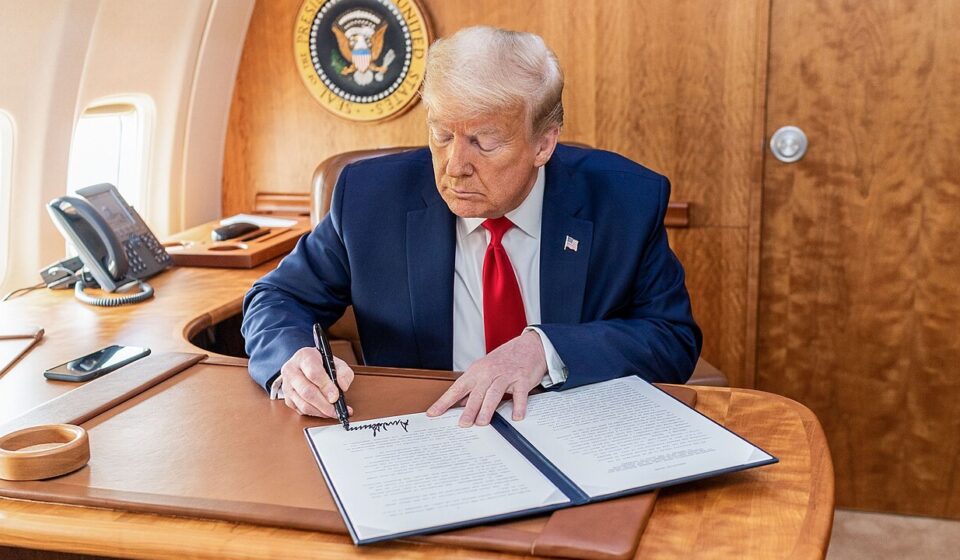


President Donald Trump signs an executive order aboard Air Force One in May 2020. Trump recently invoked the Defense Production Act to secure American missile stockpiles. (The White House/Shealah Craighead)
What Is the “Defense Production Act,” and Why Is Trump Using It?
Trump’s decision to invoke the Defense Production Act comes as the Pentagon faces a worrying shortfall in missile stocks.
Last week, President Donald Trump invoked the Defense Production Act (DPA), a Korean War-era law that gives the federal government extraordinary powers to accelerate production for national security purposes. In the order, Trump told Secretary of Defense Pete Hegseth to “provide for the making of voluntary agreements and plans of action to help provide for the national defense.”
The move comes as concerns grow over US munitions inventories, depleted through Operation Epic Fury and through America’s long-term support for Ukraine since February 2022 and Israel since October 2023.
What Exactly Is the Defense Production Act?
The Defense Production Act was passed in 1950 during the Korean War to ensure that the US could rapidly mobilize industry during national emergencies. The basic concept was that when national security was at stake, the government could intervene in the private sector to prioritize defense production. Seventy-six years later, the DPA remains one of Washington’s most powerful industrial policy tools; it has been used for Cold War mobilization, post-9/11 defense efforts, pandemic supply chains, and military production programs.
The DPA’s most immediate authority allows the government to prioritize military contracts over commercial orders. In practical terms, a supplier producing critical components with both commercial and military applications can be ordered to fulfill Pentagon needs before civilian ones. Examples include missile electronics, guidance systems, specialty metals, and microchips. As many defense programs share suppliers with commercial industries, the Pentagon is attempting to ensure military production receives priority access.
The second major tool of the DPA is that the government can directly support industrial expansion, rather than through private defense contractors as is usually the case. This includes new assembly lines, factory upgrades, specialized tooling, and workforce development. The goal is to increase long-term manufacturing capacity rather than simply reshuffle existing production. From the view of the administration, some bottlenecks require additional infrastructure, not just additional contracts.
Why Is Trump Using the DPA Now?
The reason Trump is using the DPA now centers on munitions. Recent conflicts have consumed enormous quantities of advanced weapons. Areas under particular pressure include Standard Missiles (SM-2 and SM-6), Patriot interceptors, THAAD interceptors, Tomahawk cruise missiles, and other precision-guided munitions. Defense planners have repeatedly warned that modern conflicts consume munitions far faster than previous conflicts. As a result, production has struggled to keep pace with operational demand.
The issue isn’t simply about money, but about deeper industrial bottlenecks. The single largest constraint is solid rocket motors, which are difficult to make and used in every American missile. Other specialized components are hard to source, like seeker heads, specialized electronics, and advanced materials. And these parts rely on skilled labor, with many positions requiring years of training and security clearances. The result is that, even when funding exists, production cannot instantly surge.
The unspoken backdrop to America’s missile shortage is China. Pentagon planning for the Indo-Pacific relies heavily on missile inventories, air-defense interceptors, and long-range precision weapons. Concerns are rising that the weapons used today, in a strategically questionable conflict like Epic Fury, will not be available for more obviously important conflicts such as a defense of Taiwan in the future. The administration is thus arguing that the industrial base must be strengthened before any larger crisis emerges; the DPA is designed to accelerate that process.
The White House position holds that the goal is to allow defense companies and suppliers to coordinate more effectively and address systemic industrial bottlenecks. Defense officials emphasize that the effort is designed to improve supply-chain visibility and production efficiency. The DPA invocation clearly signals that the administration views production capacity as a significant national security concern.
About the Author: Harrison Kass
Harrison Kass is a writer and attorney focused on national security, technology, and political culture. His work has appeared in Tablet, City Journal, The Hill, The Spectator, and The Cipher Brief. He holds a JD from the University of Oregon and a master’s in Global & Joint Program Studies from NYU. More at harrisonkass.com.
The post What Is the “Defense Production Act,” and Why Is Trump Using It? appeared first on The National Interest.