
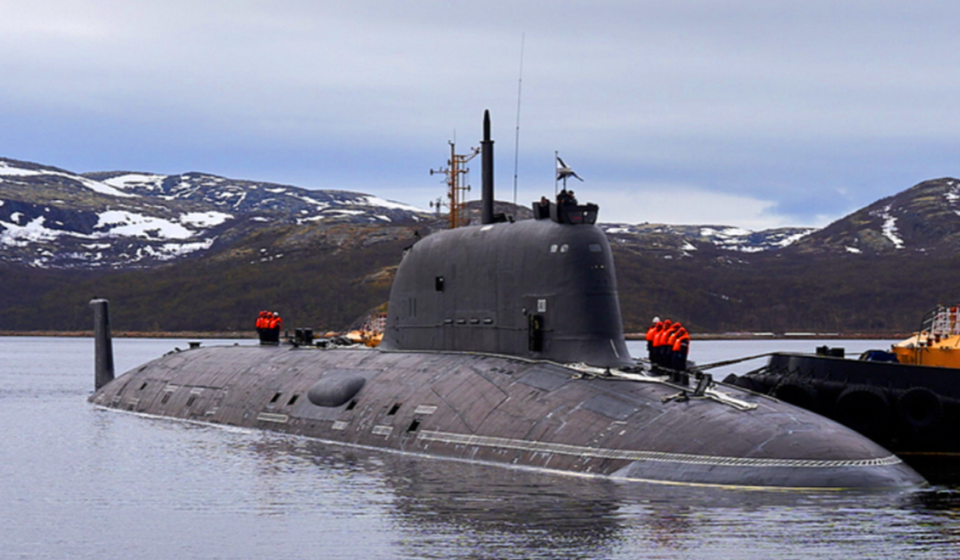


The Kazan, a Yasen-class submarine, seen in an unspecified location in northern Russia in June 2021. The Russian government recently laid the keel of the ninth Yasen-class submarine, although only five are in service. (Russian Ministry of Defense)
Russia Is Building Yet Another Yasen-M-Class Submarine
The Russian Navy wants a total of 12 Yasen-class submarines, though none are in the all-important Black Sea Fleet for use against Ukraine.
The Russian Navy continues to maintain a formidable undersea force that includes a mix of nuclear-powered and conventional diesel-electric submarines. Its capabilities could be further increased as the Sevmash Shipyard announced that it has laid down the latest Project 885M Yasen-M-class multipurpose nuclear-powered cruise missile submarine (SSGN).
“On June 17, 2026, the Sevmash Shipyard held an official ceremony to lay down the Project Yasen-M multipurpose nuclear-powered submarine cruiser Murmansk. The name of the nuclear-powered submarine has been assigned by order of Navy Commander-in-Chief Fleet Admiral Alexander Moiseyev,” the Russian Ministry of Defense said in a statement to state news agency TASS.
The Murmansk is the ninth submarine of the Yasen-M Project, the ministry added.
The Yasen-M (Project 885M) Submarine’s Specifications
- Year Introduced: 2014 (Severodvinsk)
- Number Built: 6 (12 planned)
- Displacement: 8,600 tons (surfaced) | 13,800 tons (submerged)
- Length: 130 meters (430 ft)
- Beam (Width): 13 meters (43 ft)
- Propulsion: 4th-generation KTP-6 natural circulation reactor and OK-650KPM pressurized water reactor
- Speed: 20 knots surfaced | up to 31-35 knots submerged (approx. 40 mph)
- Armament:
- Vertical Launch System (VLS): 8 cells equipped with the UKSK system to fire 32 missiles (e.g., 4 × missiles per cell). Compatible with 3M22 Zircon (hypersonic), P-800 Oniks (supersonic anti-ship), and Kalibr (land-attack/anti-ship) cruise missiles
- Torpedo Tubes: 10 × 533mm heavy torpedo tubes. Capable of deploying standard heavyweight torpedoes (UGST-M / Futlyar), rocket torpedoes, and naval mines.
- Sensors: Uses the highly sensitive Irtysh / Amfora spherical bow sonar suite which spans much of its forward section.
- Crew: 64 crew members
Russian Officials Hype Capabilities of Sevmash Shipyard
The Sevmash Shipyard, the largest in Russia, is located in the city of Severodvinsk in Russia’s northwestern Arkhangelsk Oblast, on the coast of White Sea at the mouth of the Northern Dvina River. It has exclusively built all of the Project 885M boats, including the lead submarine Kazan. Currently, four Russian SSGNs are under construction at the access-restricted port.
At the recent keel-laying ceremony, Russian Navy Commander-in-Chief Fleet Admiral Moiseyev made a point of suggesting that Russia produces some of the “world’s best nuclear-powered submarines,” a feat that few countries can even afford to do.
“Not every country can afford to build such ships, namely, nuclear-powered submarines,” Moiseyev said. “We build the best ships, the best nuclear-powered submarines. This is the result of the huge, revolutionary, collective work of our entire country.”
Though calling any vessel the “best” is inherently subjective, Moiseyev was basically correct to assert Russia’s world-beating submarine capabilities. Only six nations—Russia, the United States, the United Kingdom, China, France, and India—have produced nuclear-powered submarines, although the trilateral AUKUS program with the US, the UK and Australia could add the latter to the exclusive club. In addition, Brazil, South Korea, and North Korea are actively pursuing nuclear submarines of their own.
There are currently two shipyards in the United States capable of building nuclear-powered submarines: General Dynamics Electric Boat in Groton, Connecticut; and Huntington Ingalls Industries (HII) Newport News Shipbuilding in Newport News, Virginia.
The Yasen-Class Boats Are the Pride of the Russian Navy
Russia has long-touted the capabilities of its Yasen-M SSGNs. Development began at the end of the Cold War, initiated by the Leningrad-based Malakhit Design Bureau. Project 885 was intended to introduce a new class of SSGNs to replace the aging Akula-class nuclear-powered attack submarines in service with the Soviet Navy.
Progress slowed following the dissolution of the Soviet Union, and the baseline Project 885 lead nuclear-powered underwater cruiser Severodvinsk was laid down in 1993. However, due to funding issues as a result of the post-Cold War Russian financial crisis, the project languished for more than a decade. It was only in the late 2000s that the Kremlin was again able to return to the project.
Severodvinsk was finally launched in June 2010, and subsequently commissioned in late December 2013. The submarine entered service with the Russian Navy in 2014.
The long production delay meant that the Project 885 submarines were on the verge of obsolescence, resulting in the program’s modernization. A second boat, the upgraded Project 885M lead submarine Kazan, also saw delays, yet was built in eight years, or roughly half the time of the Severodvinsk.
The Yasen-M revision further offered revamped onboard electronics, a slightly reduced overall length, and reportedly a new KTP-6 reactor that is believed to reduce the submarine’s noise levels significantly. The upgraded Project 885 submarines are also noted for utilizing new technological developments that emerged since Severodvinsk started construction in 1993.
Unlike the older attack submarines that were built in the late Soviet period, the Project 885/885M boats were specifically developed to serve as multi-purpose vessels. Each could carry a variety of weapons, including the most advanced new long-range Tsirkon hypersonic cruise missiles.
The Kazan and subsequent boats were also equipped with the UKSK (3P-14B) vertical launch system consisting of 8SM-346 modules. The universal vertical launching system (VLS) features eight of these SM-346 launcher modules, providing the submarine with up to 32 missile cells. Each of the eight modules can store and fire up to four P-800 Oniks anti-ship missiles or five 3M54-1 Kalibr cruise missiles.
“Submarines of this Project incorporate the most advanced achievements of domestic science, technologies and unique design solutions. These are advanced effective seaborne combat systems capable of accomplishing the entire set of the Navy’s objectives on their own and as part of multiservice force naval groups practically in any part of the World Ocean while remaining invisible to others,” explained Admiral Moiseyev.
The Russian Navy currently operates five Yasen-class nuclear-powered submarines, with four more subs at various stages of construction.
“We have four more at various stages of their construction,” Moiseyev said. “The program stipulates the annual keel-laying of such ships to meet the needs of the state and the Navy.”
It was reported that the still-under-construction boats will eventually operate with the Russian Navy’s Northern and Pacific Fleets.
About the Author: Peter Suciu
Peter Suciu has contributed to dozens of newspapers, magazines and websites over a 30-year career in journalism. He regularly writes about military hardware, firearms history, cybersecurity, politics, and international affairs. Peter is also a contributing writer for Forbes and Clearance Jobs. He is based in Michigan. You can follow him on Twitter: @PeterSuciu. You can email the author: Editor@nationalinterest.org.
The post Russia Is Building Yet Another Yasen-M-Class Submarine appeared first on The National Interest.