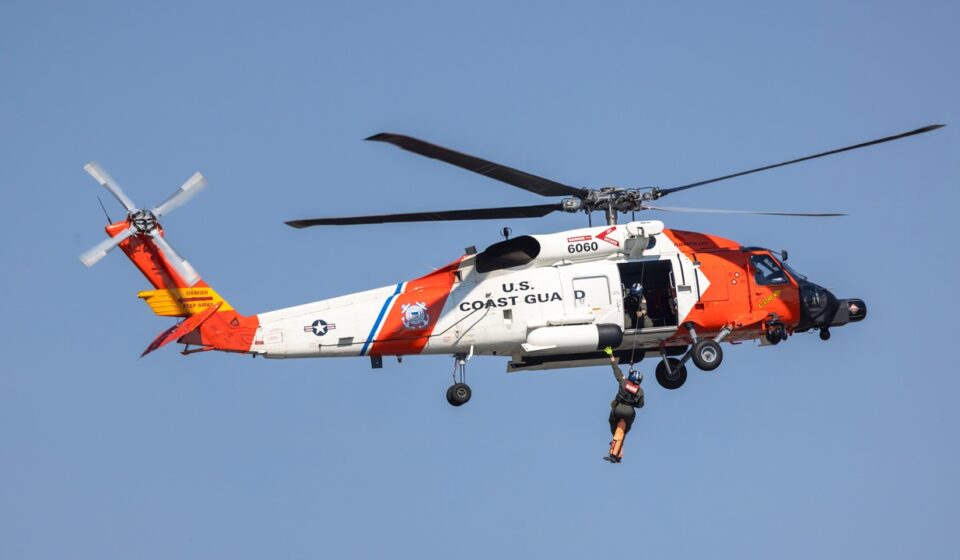


A US Coast Guard MH-60 Jayhawk helicopter flies during an airshow in Virginia Beach, Virginia, in September 2025. A similar aircraft recently crashed in Alaska, resulting in minor injuries to the crew. (Shutterstock/Spencer Hart)
US Coast Guard Crew Safe After Helicopter Crash in Alaska
The crash took place near the city of Sitka, Alaska, and the Coast Guard praised local first responders for quickly coming to the downed crew’s aid.
Just a week after a United States Air Force Boeing B-52 Stratofortress crashed on takeoff at Edwards Air Force Base (AFB), California, killing eight servicemembers, a United States Coast Guard MH-60 Jayhawk helicopter crashed on Monday morning during a training flight near Sitka in southeastern Alaska.
“Rescue crews from Sitka Fire and Rescue arrived on scene at approximately 11:00 a.m. and transported all four crew members to Mt. Edgecumbe Medical Center. No deaths have been reported,” the US Coast Guard Arctic District said in a media statement on Monday.
The Coast Guard added that the cause of the crash was under investigation, but provided no additional details.
“We are incredibly relieved our crew members survived with only minor injuries,” Rear Adm. Bob Little, commander of the Coast Guard’s Arctic District, told the Juneau Independent. “We are grateful for the swift response by the Sitka Fire and Rescue who assisted us during this critical time.”
MH-60 Jayhawk Crashes Are Rare, but Not Unheard Of
This is the first aerial mishap involving the Coast Guard since March 2010 when an HH-60 Jayhawk crashed into the Uinta Mountains, Utah, at 9,400 feet while returning from a security detail for the Vancouver Winter Olympics. All five crewmembers survived the incident, although three were seriously injured.
Prior to that, another HH-60 Jayhawk involved in rescuing the sinking cargo ship M/V Selendang Ayu in December 2004 was hit by a massive wave, which forced the Sikorsky aircraft into the water. The helicopter crew was rescued, but six of the sinking ship’s crewmembers died in the incident.
Despite being a branch of the US military, the US Coast Guard is part of the Department of Homeland Security in peacetime.
MH-60 Jayhawk Specs
- Year Introduced: 1990 (as the HH-60J)
- Number Built: ~51
- Length: 65 ft 0 in (19.8 m)
- Rotor Diameter: 53 ft 8 in (16.4 m)
- Weight (MTOW): 21,884 lb (9,926 kg)
- Powerplant: Two General Electric T700-GE-401C turboshaft engines (1,890 shp each)
- Top Speed: 180 knots (207 mph / 333 km/h)
- Range: 700 nmi (805 mi, 1,300 km); 6.5 hours’ endurance
- Service Ceiling: ~5,000 ft (1,500 m) hovering
- Loadout:
- Rescue Hoist: 250-foot cable with a 600 lb lift capability
- Sensors: Integrated digital glass cockpit, surface search radar, and electro-optical/infrared (EO/IR) sensors
- Payload Capacity: 7,384 lb (3,350 kg)
- Armament: Configurable for Airborne Use of Force (AUF) with a .50-caliber precision fire weapon and an M240 7.62 mm machine gun for warning shots
- Crew: 4 (pilot, co-pilot, flight mechanic, rescue swimmer)
The MH-60 was developed in the late 1980s to replace the aging HH-3F Pelican, and is based on the United States Navy’s SH-60 Seahawk, and a variant of the Sikorsky family of S-70 helicopters. According to the United States Coast Guard, the Jayhawk serves as “an all-weather medium range recovery (MRR) helicopter that provides multi-mission capabilities in support of Coast Guard and Department of Homeland Security (DHS) missions.”
Aerospace and defense giant Lockheed Martin, the parent company of Sikorsky, claims that since the MH-60 Jayhawk entered service in 1990, it has been employed to save more than 13,000 lives, and has “demonstrated its capability to perform critical search and rescue, law enforcement, and marine environmental protection missions.”
In 2017, the US Coast Guard initiated a service life extension program (SLEP) to upgrade approximately 45 of the helicopters in the fleet that would have otherwise reached their end of life by 2028.
About the Author: Peter Suciu
Peter Suciu has contributed to dozens of newspapers, magazines and websites over a 30-year career in journalism. He regularly writes about military hardware, firearms history, cybersecurity, politics, and international affairs. Peter is also a contributing writer for Forbes and Clearance Jobs. He is based in Michigan. You can follow him on Twitter: @PeterSuciu. You can email the author: Editor@nationalinterest.org.
The post US Coast Guard Crew Safe After Helicopter Crash in Alaska appeared first on The National Interest.