
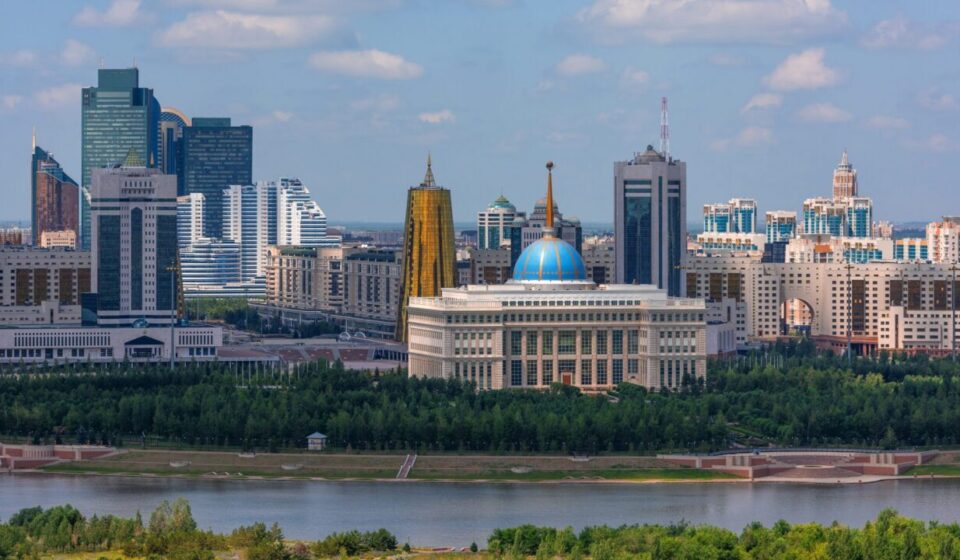


An aerial view of the central part of the capital of Kazakhstan, the city of Astana, with the residence of the president of Kazakhstan on a summer day, circa August 2024. Kazakhstan’s ambitions will require political reform as much as they require economic reform. (Shutterstock/MaxZolotukhin)
Kazakhstan’s Bold Bid for Middle Power Status
The Central Asian nation’s transformation will depend as much on governance reform as it will on economic growth.
Host to historical levels of business and diplomatic engagement, Kazakhstan in 2026 is no longer best understood as a pawn-state caught balancing between its great-power neighbors. Instead, it is emerging as a country pursuing something far more ambitious: realigning itself geopolitically through an innovative, reconfigured approach to connectivity. In doing so, the country is working to position itself as more than a gas station on a remote Central Asian freightway. Kazakhstan seeks to transform itself from a hydrocarbon economy into a strategic “middle power” whose significance extends beyond the immediate region.
Since 2022, President Kassym-Jomart Tokayev has pursued a broad reform agenda under the banner of a “New Kazakhstan,” combining constitutional changes, trans-Caspian infrastructure investments, and expanded engagement with Europe, the United States, and the Gulf. No longer is the question whether Kazakhstan intends to change, but how. Moscow, Beijing, and Tehran have long served as constraints to Central Asia’s independent progress and narrowed its aperture of engagement.
Whether Astana can capitalize on the current geopolitical moment will define its next phase of development. Securing greater regional and global connectivity will provide greater flexibility for Kazakhstan’s exports, including investments in the Middle Corridor. This emerging trans-Caspian trade route connects Central Asia with the South Caucasus, enabling access to Europe. It will also create partnerships that reduce dependence on Russia and China while supporting a more diversified economy.
Despite substantial critical mineral wealth and ambitions in manufacturing and logistics, Kazakhstan’s economic model remains tightly tethered to hydrocarbons. Dominating export revenues, the oil and gas sector has accounted for over 30 percent of GDP and 75 percent of exports. In 2025, Kazakhstan became one of the European Union’s three largest crude suppliers alongside Norway and the United States. In the last decade, Astana has more than doubled its crude oil supply to the EU, reflecting Europe’s diversification efforts, Kazakhstan’s expanded production, and Russia’s declining market share after its 2022 invasion of Ukraine.
Yet this apparent success is marred by a critical economic vulnerability. The vast majority of Kazakhstan’s crude exports to Europe depend on the Caspian Pipeline Consortium (CPC) pipeline. This internationally owned conduit carries roughly 80 percent of the country’s oil exports to Black Sea ports. Carrying roughly 1.5 percent of the global daily oil supply, the CPC, which transits through Russian territory, is subject to Russian law, is managed by Russian workers, and is vulnerable to political pressure from Moscow.
How Sanctions Catalyzed Kazakhstan’s Economic Diversification
Russia has repeatedly interfered with the CPC pipeline’s flow through stoppages, inspections, and court rulings that conspicuously coincided with periods of political tensions between Astana and the Kremlin. In 2022, the US Office of Foreign Assets Control (OFAC) carved out an exception to help insulate Astana’s oil exports that transit through the CPC from Russian sanctions. However, multiple CPC disruptions have threatened the country’s economic bottom line and incentivized Astana to prioritize export alternatives despite fears of Russian retaliation. As a landlocked exporter with Moscow’s hand firmly poised over its main export artery, Astana receives an unmistakable message: the geography of its infrastructure constrains the country’s economic and political sovereignty.
This structural reality is hastening a strategic shift. Diversification on multiple fronts is not just a policy preference but a macroeconomic necessity for Central Asia’s largest economy. Kazakhstan’s growing investment in a westward corridor spanning the Caspian Sea, the South Caucasus, and Turkey reflects a decision to reduce its exposure to Russia’s coercive leverage while expanding its integration into European and global markets.
Tokayev’s “New Kazakhstan” model seeks to use its hydrocarbon revenues as a transitional bridge to next-generation industries, including rare-earth processing, logistics hubs, and digital infrastructure. Kazakhstan’s leadership recognizes that long-term stability requires moving beyond extractive exports and capturing greater value across entire supply chains. The logic of KazMunayGas’s downstream expansion into European markets, therefore, includes opening refineries and a network of fuel stations in Romania and other countries along the Black Sea energy corridor. As Europe recalibrates its energy suppliers, Kazakhstan is positioning itself as a well-to-tank purveyor for the European energy network.
This same logic extends to transport policy. Kazakhstan’s investment in the Trans-Caspian International Transport Route, commonly referred to as the Middle Corridor, reflects a broader transformation in how connectivity shapes Kazakhstan’s and the region’s future economic trajectories. Rail expansion, port development, and logistics integration are not seen as technical upgrades, but as critical elements of economic policy. Critical and expensive upgrades to the Aktau and Kuryk ports demonstrate this commitment.
The Middle Corridor’s Limitations
The corridor’s significance has grown dramatically since 2022, with growing cargo volumes as European and Asian entities seek an alternative to Russian transit. Kazakhstan has invested heavily in ports, logistics facilities, and rail infrastructure across the Middle Corridor.
A nearly 70 percent increase in rail freight between Kazakhstan and Georgia in the first half of 2025 is one indicator of progress and increasing trade flows. Bilateral trade between the two countries reached $184.5 million in 2025. These developments are not isolated infrastructure projects but rather reflect Astana’s broader philosophy of soft balancing, which reorients its geopolitical future westward without losing its eastern relationships.
Despite significant attention and investment, the Middle Corridor’s development faces several distinct limitations. Capacity chokepoints at Caspian ports, rail restrictions, customs inefficiencies, limited ferry infrastructure, and disjointed coordination between multiple authorities continue to constrain headway. The escalating pressure to expand capacity, improve transit times, and reduce transport costs poses a major challenge for Astana and its corridor partners in matching operational capabilities with strategic ambitions.
The country’s ambitions complement physical trade routes with efforts to expand its digital infrastructure. Along with a trans-Caspian subsea fiber-optic cable project, Starlink’s expansion into Kazakhstan supports Astana’s efforts to secure its digital sovereignty and to become a digital transit hub for data flows between China and Europe.
Kazakhstan Wants to Refine, Not Just Mine, Critical Mineral
Critical minerals form another mainstay of Astana’s new strategy and are essential for global defense industries, electric vehicles, and advanced semiconductor supply chains. Kazakhstan possesses substantial reserves of rare earths, uranium, tungsten, copper, titanium, and other strategically significant materials that have become central to global industrial and technological competition. To further develop its resource base, the country has secured nearly 70 percent of total foreign direct investment in Central Asia, far outstripping its regional peers and making it an increasingly attractive target for Western, Chinese, Turkish, Gulf, and Korean investment.
Yet Kazakhstan seeks to evolve beyond its Soviet-era self as primarily a source of raw materials. Instead, Astana is seeking to develop processing and refining capabilities that, following China’s model, add significant value to its resources through mid-stream processing and the manufacturing of high-value products. Such bold aims require significant investments in construction, technology, and new partnerships that work to develop markets for these industries. In pursuing new market partners, Astana must also maintain ties with its traditional partners.
In a counterbalancing effort, Astana is pursuing a multi-vector approach that encourages Western investment as a potential non-Chinese source of strategic minerals, such as the American-linked Cove Capital investment in tungsten, which reflects a strategic effort to de-risk US supply chains from Chinese dominance. At the same time, Chinese investment is being aggressively courted to expand and develop Kazakhstan’s mining sector, with mega projects such as Zijin Gold International’s $1.2 billion acquisition of the Raygorodok gold project.
The “New Kazakhstan”: Old Wine, New Bottles?
Rather than choosing between East and West, Kazakhstan is simultaneously integrating into multiple, interrelated supply chains. The “New Kazakhstan” no longer seeks to be a passive bystander in great-power equations but increasingly works as a self-proclaimed “middle power” to maximize the benefits of engagement with competing geopolitical systems. Astana’s goal is to secure the greatest domestic value from foreign investment by using it not only for immediate economic gains, as in developing mining capacity, but also to strengthen Kazakhstan’s longer-term technological capabilities, industrial base, and strategic independence.
The result of this broader transformation ultimately depends not only on infrastructure and investment, but on the country’s domestic governance. President Tokayev’s reform agenda is touted as a cornerstone of Kazakhstan’s transformation. Recent constitutional changes and governance restructuring aim to rebalance institutional authority and enhance accountability. But will the new one-chamber parliament be more open to, and more representative of, civic input than its two-chamber predecessor? Questions remain regarding the depth and durability of these and other such reforms.
The country’s 35 years of independence are marked by multiple referenda and reform initiatives that were only partially implemented, often to be reversed in subsequent ballot measures. Though many of the recent structural revisions are potentially significant, their ultimate impact will depend on implementation and transitioning the country’s institutional culture.
Tacit in these overhaul, revitalization, and relaunch efforts is an underlying recognition that civic sentiment expects more from its government. Anti-monopoly initiatives, decentralization efforts, and the leadership’s framing of a more responsive “Listening State” are, in no small measure, a response to the January 2022 unrest, which exposed deep public frustration with the pre-Tokayev-era elite’s concentration of wealth and power. Mass protests and labor unrest have fundamentally placed Kazakhstan’s government on notice that it needs to deliver better opportunities for its citizenry.
The Limits of Kazakhstan’s Economic Growth
What emerges in 2026 is not a country abandoning its past relationships, but one attempting to widen its range of strategic options. Beneath Kazakhstan’s impressive headline growth figures, persistent structural constraints remain. Having entered the world’s top 50 economies by GDP in 2025, with an economy approaching $320 billion in 2026, the country nevertheless continues to face inflationary pressures, uneven wage growth, hydrocarbon dependence, and the long and unfinished process of institutional reform.
For all of its momentum, Kazakhstan’s transformation remains a work in progress. Astana has recently become more assertive in managing its resource sector, using arbitration cases and stricter oversight of production-sharing agreements with Chevron, Exxon, and other major investors to strengthen its fiscal position and leverage for dealing with international partners.
While reinforcing its control over strategic assets, Astana’s actions also raise serious questions among foreign investors about regulatory and contract predictability, particularly as foreign direct investment is critical for the country’s ambitions to build out its mineral and tech sectors. Recent disputes involving Russian firms have demonstrated the continued limits of Kazakhstan’s strategic autonomy despite efforts to strengthen legal independence and international arbitration mechanisms.
Fully aware of its limitations, Kazakhstan’s leadership today is working to define itself less by geography alone than by its efforts at repurposing that geography into leverage. Key to this effort is the country’s deep connectivity to a stable South Caucasus and the viability of trans-Caspian trade and transit corridors that link Central Asia to Europe. The future of connectivity through Armenia, Azerbaijan, and Georgia is a critical component of Astana’s diversification strategy and its effort to reduce its overreliance on traditional routes through Russia.
Kazakhstan’s strategy is increasingly coherent. From pipelines and railroads to fiber-optic cables and logistics hubs, Astana is seeking to diversify exports, advance in critical mineral value chains, expand digital and transport connectivity, and reduce vulnerability to external pressure while maintaining productive relations with all major powers. The ambition is clear, but implementation remains uneven and structural constraints formidable.
Whether the “New Kazakhstan” succeeds may depend less on infrastructure than on governance. Kazakhstan’s institutions must evolve as quickly as its infrastructure. Governance capacity must keep pace with geopolitical aspirations. The rails are being laid, literally and figuratively. Whether Astana can fully capitalize on this moment will determine not only the future of the “New Kazakhstan” but also the evolution of Eurasia itself.
About the Author: Eric Rudenshiold
Dr. Eric Rudenshiold served for four years as the US National Security Council’s Central Asia Director under presidents Donald Trump and Joe Biden. He is currently a senior fellow at the Washington office of the Caspian Policy Center. Prior to serving at the NSC, Dr. Rudenshiold served in a variety of capacities for the US Agency for International Development from 2007 to 2018, including acting roles as deputy assistant administrator, country office director, director for South and Central Asia, senior officer in charge of Central Asia, and senior adviser.
The post Kazakhstan’s Bold Bid for Middle Power Status appeared first on The National Interest.