
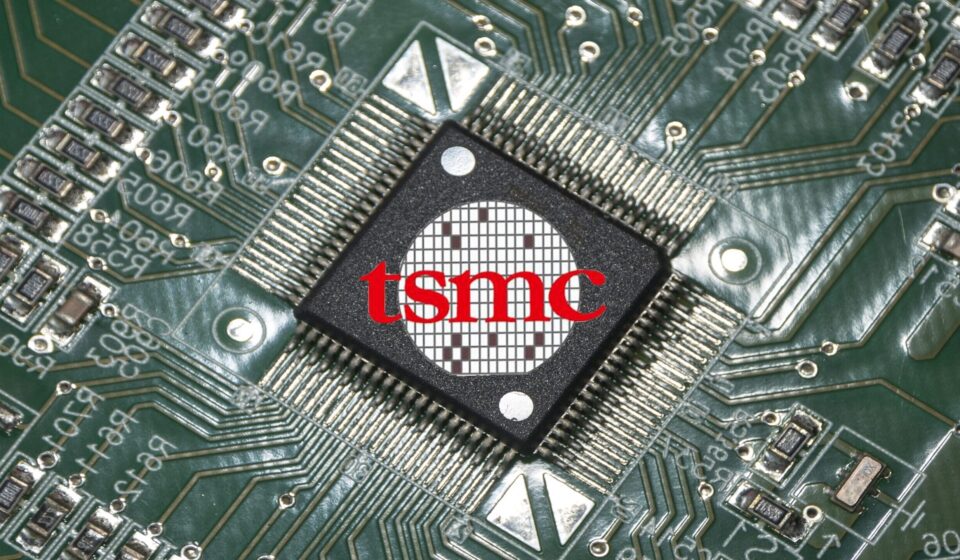


TSMC is written on an AI chip. Taiwan Semiconductor Manufacturing Company (TSMC) plays a central role in advanced semiconductor manufacturing and the geopolitical competition over AI compute and export controls. (Shutterstock/Ricky kuo)
In the AI Race, Export Controls Are Dividing the Global Compute Ecosystem
The AI race is increasingly about controlling the chips and infrastructure that power them.
Earlier this month, Taiwan announced it is establishing new export controls on advanced artificial intelligence (AI) chips en route to China. These new controls would extend restrictions beyond firms like Huawei, which are already blacklisted, and apply to consumers importing AI hardware into China as a criminal offense.
As part of ongoing trade negotiations with the United States, the proposal would pull Taiwan, the country that manufactures the world’s most sophisticated processors, into the American export-control arena. This is a marginal bureaucratic step, but it carries immense implications: a world where computing power is segmented along geopolitical lines.
Quite often, the race to lead in AI is understood as a competition to produce the most cutting-edge models and attract lucrative talent. However, the more durable advantage in leading this frontier lies in being able to produce the physical infrastructure that makes complex AI computation possible.
The jurisdiction that ends up controlling the supply of advanced semiconductors and the energy systems that power themwill have the authority to set standards for how the next generation of this technology develops. This includes how these technologies are regulated and where they are redirected. In particular, that control is a matter of who gets to decide where these semiconductor chips may be exported.
Jurisdictions around the globe are weaponizing export controls as a means of projecting power over computation development. Governments are able to shape the speed and direction of AI development across borders by simply restricting which countries and firms can buy the high-performance processors, along with the fabrication equipment that powers them.
AI ultimately depends on powerful computing. From there, the compute power and quality depend on a set of advanced chips to do the job. The production of these particular chips depends on a supply chain that is centralized in a select group of countries. When a jurisdiction controls any chokepoint along that chain, it gains leverage over the manufacturing ecosystem.
As export controls continue to tighten globally, the AI ecosystem risks dividing into rival compute blocs. This division triggers a set of roadblocks in the development of advanced AI models, including raising production costs, slowing innovation, fragmenting standards and research, and reducing the economic interdependence that has helped maintain stability in the Taiwan Strait region.
US Chip Export Controls Tighten Grip on Global AI Compute
The United States recently strengthened enforcement of chip export controls, which further minimized the loopholes that had previously allowed China to acquire advanced chips through overseas subsidiaries. Now, the United States is pushing to further restrict the supply chain by increasing oversight of contract manufacturers such as Taiwan Semiconductor Manufacturing Company (TSMC), which are responsible for fabricating chips. Contract manufacturing is the core of the industry, with only a select group of facilities producing the most widely sought-after chips that major firms depend on. Exercising tighter export oversight over these facilities gives the United States a strategic advantage over the world’s supply of the leading compute, governing the chokepoint and therefore, the ecosystem.
Taiwan Aligns With US AI Chip Restrictions as China Builds Domestic Compute
Taiwan is aligning with the United States’ approach, for both strategic and commercial reasons. The country is working on placing strict export controls on AI chips to China and looking to penalize circumvention of the rules. Ultimately, the security ties it has established with the United States function through the same industrial base that the export controls are intended to safeguard. An alliance on enforcement only further helps protect that base.
In response to this coordinated front, China is developing a nationwide AI infrastructure push reportedly worth $295 billion. China’s aim is to reduce its reliance on US-controlled chips by building independent compute capacity. The push would ultimately help finance domestic chip production: manufacturing, design, and the data center and energy infrastructure to run AI internally.
AI Compute Blocs Threaten Global Innovation and Taiwan Stability
Ultimately, the AI ecosystem is splitting in two: with one bloc built on US chip design and manufacturing in places such as Taiwan and Japan, and the other based on China’s plans for semiconductor self-sufficiency.
However, at the center of this geopolitical rivalry sits the US company Nvidia and, on the other side, the Chinese company Huawei. Taiwan and TSMC are hedged in between as the chokepoint that both blocs depend on. With the emergence of these compute blocs, we are beginning to see parallel stacks for AI development, each with its own chips, processes, and rulebook.
Ultimately, the race to lead in AI has become one to dominate in computing abilities and chip manufacturing. The overarching risk here is that these blocs could increase compute costs and slow progress due to fragmented standards and research. The risks of a parallel system could also carry over geopolitically, removing the interdependence that had previously paused the conflict over Taiwan for many years. In essence, export controls are slowing this rivalry, but in the long term, they are pushing for a global AI landscape that is more expensive and less innovative than before.
About the Author: Emily Vartuhi Ekshian
Emily Vartuhi Ekshian is a Young Voices contributor based in Washington, DC. She is a graduate of Columbia University, Graduate School of Journalism, MS program. Emily is interested in reporting on the emerging technologies sector, such as digital asset policy, blockchain, AI and tech use-cases for public good.
The post In the AI Race, Export Controls Are Dividing the Global Compute Ecosystem appeared first on The National Interest.