
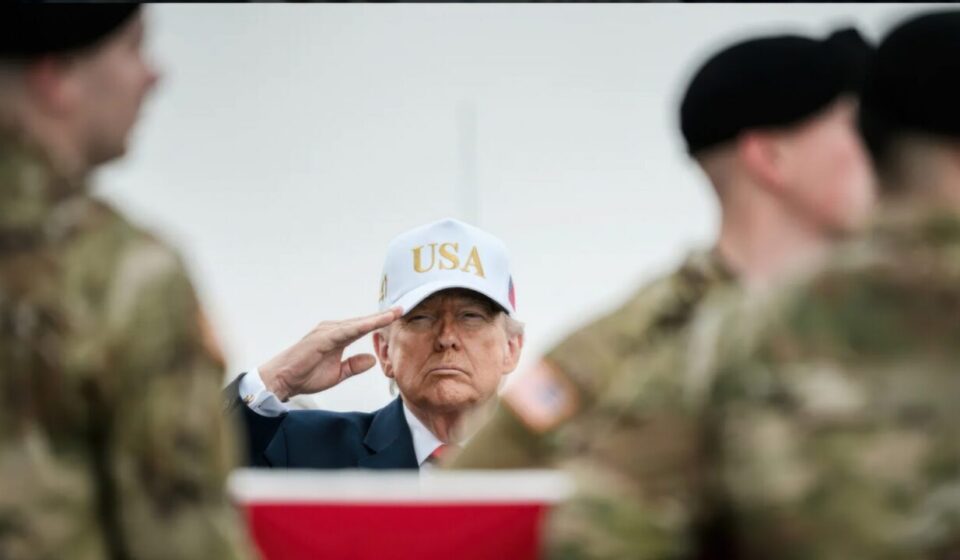


President Donald Trump attends the dignified transfer at Dover Air Force Base in Delaware, on March 7, 2026, of six US Army Reserve soldiers killed in the Iran War. The US-Iran memorandum of understanding includes limited concessions from Iran. (Shutterstock/Robert V Schwemmer)
The Iran War’s Incoherent Peace Deal
While the end of the war will be welcome to the global economy, it will do little to prevent Iran’s nuclearization.
The virtue of President Donald Trump’s “deal” with Iran is that it augurs the end of an unnecessary, illegal, and costly war. But this remarkable document gives the “defeated” Iran far more than it gives the “victorious” United States. Indeed, it is hard to see why the negotiations took so long—Iran would have been happy to sign this deal before the first bomb fell.
In the “memorandum of understanding” that Trump signed at Versailles, the United States promises to lift all sanctions on Iran (even those related to its support for terrorism and human rights violations), to release Iranian assets frozen by sanctions (to go to “any ultimate beneficiary” Iran chooses, presumably including Hamas or Hezbollah), to remove its forces from areas near Iran, and to organize $300 billion in investments for reconstruction. Under the deal, the United States has already lifted oil sanctions and begun unfreezing Iran’s assets, strengthening the Iranian regime with a flow of billions of dollars not available to it before.
But Iran, while repeating past promises not to seek nuclear weapons, does not agree to any limits on its uranium enrichment, or any international monitoring of its nuclear program (beyond monitoring of blending down its stockpile of near-bomb-grade material). After the first round of follow-on talks, Vice President JD Vance proudly announced that Iran had now agreed to permit international monitoring of its program—only to have Iran publicly deny that it had agreed to allow any inspections of the sites the United States bombed last year. Nor has it agreed to keep the Strait of Hormuz open and fee-free beyond the first 60 days, or to stop supporting armed groups throughout the region, or to limit its missile program.
The agreement does speak vaguely about blending down Iran’s stock of near-bomb-grade uranium—material that would not exist today had Trump not pulled out of the Obama administration’s Iran deal—but it is not much of a commitment. Had a Democratic administration launched such a war and then signed such a pact, the motion to impeach the president would already have been filed.
To be sure, negotiations of a “final” agreement, just begun, are to take place over 60 days (extendable if both sides agree). The Trump team presumably hopes to get more from Iran. It is already making claims that Iran has agreed to things explicitly contradicted by the signed accord (such as that the money Iran will get would go only to buying crops from US farmers). But with most of the key topics not even mentioned in the memorandum of understanding, and so much of the US leverage already given away, there are few reasons to expect those talks to go well.
Trump’s negotiators will be facing a post-war Iranian government now run by the most extreme forces of the Iranian Revolutionary Guard Corps, who see themselves as having won this round, and who will be bolstered by the new revenue from this deal. And after being attacked twice by Israel and the United States in the past year, they have more reason than ever to pursue a nuclear deterrent to prevent further attacks.
In contrast to the crowds of experts working for years on the Obama-era deal, Trump assigned a few people who knew little about Iran and its strategic culture, the nuclear technology they sought to restrain, or the sanctions regime, its purposes, or its complexities. The deal seems to reflect their lack of expertise, as it promises outcomes beyond Trump’s control.
Under US law, Trump cannot fulfill his promise to lift all sanctions without Congress passing new legislation—and with both Democrats and Republicans attacking the deal, congressional support for this giveaway may be hard to come by. Without involving Israel, the deal promises that Israel will stop attacks in Lebanon—but as Israeli Prime Minister Benjamin Netanyahu has made clear, he has no intention of stopping.
The Trump team also promised to remove all International Atomic Energy Agency (IAEA) resolutions against Iran, but none of the violations of Iran’s inspection obligations that those resolutions addressed have been resolved, and lifting them would require a vote by the many countries on the IAEA’s Board of Governors. In short, the Trump crew has made more than a few promises they may not be able to keep, in return for very few promises on Iran’s side.
Today, Iran has no operating plants to enrich uranium, for reactor fuel or for bombs, and many of its top nuclear experts have been killed. Those are the result of the US and Israeli strikes in June 2025; this year’s war had only a modest further effect on Iran’s nuclear program, despite the rhetoric about stopping an Iranian bomb being its purpose.
But Iran still has enough near-weapon-grade uranium for over 10 nuclear warheads; major stocks of other enriched uranium (which could rapidly be further enriched for weapons use); the knowledge and experience to build and operate advanced centrifuges for such enrichment (and likely some stocks of centrifuges and parts); designs and knowledge left over from the actual nuclear bomb program it halted in late 2003, with some further work since; and deep underground facilities, beyond the reach of current US bunker-busting bombs, where much of this is stored and the work of a bomb program could be done.
In the talks on a “final deal,” it will be time for the Trump team to deal with the dangers posed by all of those Iranian capabilities—to get a deal with strict limits on Iran’s uranium enrichment and stockpiles, and effective international monitoring.
To get there, Trump will have to finally assign some experts with deep knowledge of nuclear technology and safeguards, and be prepared to take far more time than the 60 days the memorandum calls for. They will have to muster as much US leverage as they can, making clear that the promises of the memorandum of understanding will not be fulfilled without Iran agreeing to limit the threats its nuclear program poses to the rest of the world.
President Trump has said that the Iran deal negotiated in President Barack Obama’s administration, “was a road to a nuclear weapon,” while his “is a wall against a nuclear weapon in the truest sense of the word.” Both sides of that comparison are lies. The Obama-era deal, the Joint Comprehensive Plan of Action (JCPOA), obliged Iran to export 97 percent of its enriched uranium, imposed stringent limits on Iran’s uranium enrichment, banned a list of nuclear-weapon-related activities, and put in place far-reaching international inspection, going well beyond traditional IAEA monitoring.
Until the Trump administration withdrew from the deal in 2018, Iran had complied with its terms. Trump’s deal, so far, has none of that—only a paper promise not to build nuclear weapons (also included in Iranian commitments going back decades, including in the Obama deal) and a vague commitment to blend down its stock of highly enriched uranium.
Unfortunately, given the starting point of the unbalanced deal Trump has just signed, the odds are slim that his team will be able to get an effective deal in the talks to come. One way or another, the world will likely be dealing with the serious risks posed by Iran’s capability to move toward nuclear weapons for years to come.
About the Author: Matthew Bunn
Matthew Bunn is the James R. Schlesinger professor of the practice of energy, national security, and foreign policy at Harvard’s Kennedy School of Government and the co-principal investigator of the Project on Managing the Atom at Harvard Kennedy School’s Belfer Center for Science and International Affairs.
The post The Iran War’s Incoherent Peace Deal appeared first on The National Interest.