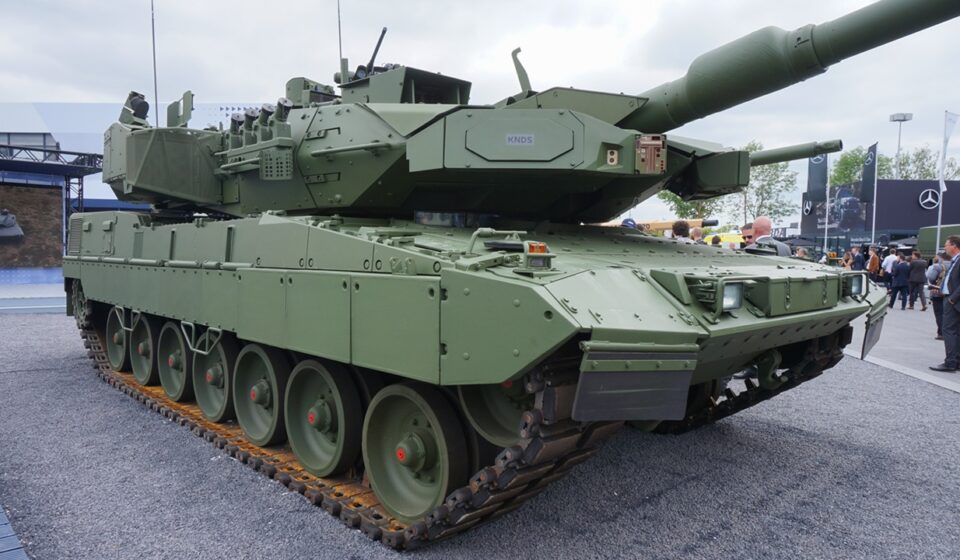


A new Leopard 2A8 tank on display at the Eurosatory Arms Fair in June 2024. KNDS, the manufacturer of the Leopard, has adapted its chassis into the newer CAPINT tank, which features a French-made turret. (Shutterstock/Spech)
After Their Last Defense Project Flopped, France and Germany Are Trying Again
KNDS, a joint Franco-German defense contractor, hopes to develop the CAPINT tank to replace France’s aging Leclerc fleet.
Last week, France and Germany officially opted to go their separate ways on sixth-gen fighter development, putting a definitive end to the Future Combat Air System (FCAS) program with Spain. It was also in April that the Franco-German Main Ground Combat System (MGCS) was reported to be in serious trouble, with that project running up to a decade behind schedule.
However, the third time could be the charm for Paris and Berlin, with another program unveiled at this week’s Eurosatory Defense Industry Exhibition, which is being held outside of the French capital.
About the Franco-German CAPINT Tank
The Franco-German defense group KNDS is now working on a stopgap tank that could replace the French Army’s aging Leclerc fleet. Dubbed the “Intermediary Capability” (CAPINT) main battle tank (MBT), it features a German tank chassis and French main gun. In addition to ensuring that France has a capable MBT to address the growing threat from Russia, it could help pave the way forward for the MGCS, which was intended to replace both the Leclerc and Germany’s Leopard 2.
The MGCS won’t enter service until sometime between 2040 and 2045. It is unclear if France’s Leclercs will last until then, and Paris may need a more capable vehicle sooner. This is where the CAPINT—which suggests intermediary capability—could come in.
The new tank would employ a KNDS Deutschland-produced chassis that is based on the Leopard 2A MBT, with an unmanned Ascalon turret armed with a 120mm main gun made by KNDS’s French division. The turret, which was developed for the Leopard 2 A-RC 3.0, was introduced at the Eurosatory Expo in 2024, Breaking Defense reported.
The CAPINT could be in service by the early 2030s. France’s Leclerc MBTs are currently scheduled to be retired from service by 2038, which necessitated the need for the “intermediate” tank program. Berlin has also been concerned about the delays with the MGCS, and last year it was announced that KNDS Germany and Rheinmetall were developing another intermediate tank, which could be designated the Leopard 2AX or Leopard 3.
Another MBT Is in Development Between Germany and Italy, Too
When it comes to MBTs, main may mean “primary” for Berlin—but there is yet another tank program underway with the joint Italian-German venture Leonardo Rheinmetall Military Vehicles (LRMV), which was founded in 2024. LRMV is presenting a mock-up of its MBT at the arms show outside of Paris.
The prospective tank was displayed with a 30mm remote-operating chain gun to counter threats from aerial drones. The MBT is reportedly being offered to the Italian Ministry of Defense.
It is unclear how long this program is right now, but according to company officials, it could also enter service in the next decade. The Italian military currently operates the C1 Ariete, which has served as the armored backbone of the Italian Army’s tank force since the 1990s. In addition, the Italian Army has begun to field the Ariete C2, which features an upgraded engine, digital fire controls, and enhanced armor. The C2 has been seen as an interim stop-gap before something better comes along, and Rome has sought to replace the fleet with around 132 more advanced, next-generation MBTs.
Italy has also been considering the still-in-development German KF51 Panther and Lynx Infantry Fighting Vehicle (IFV), but now it may be looking at other alternatives. Given the number of tank programs in the works, and the relatively low cost of building them compared to ships or fighter jets, there are plenty of options to choose from.
About the Author: Peter Suciu
Peter Suciu has contributed to dozens of newspapers, magazines and websites over a 30-year career in journalism. He regularly writes about military hardware, firearms history, cybersecurity, politics, and international affairs. Peter is also a contributing writer for Forbes and Clearance Jobs. He is based in Michigan. You can follow him on Twitter: @PeterSuciu. You can email the author: Editor@nationalinterest.org.
The post After Their Last Defense Project Flopped, France and Germany Are Trying Again appeared first on The National Interest.