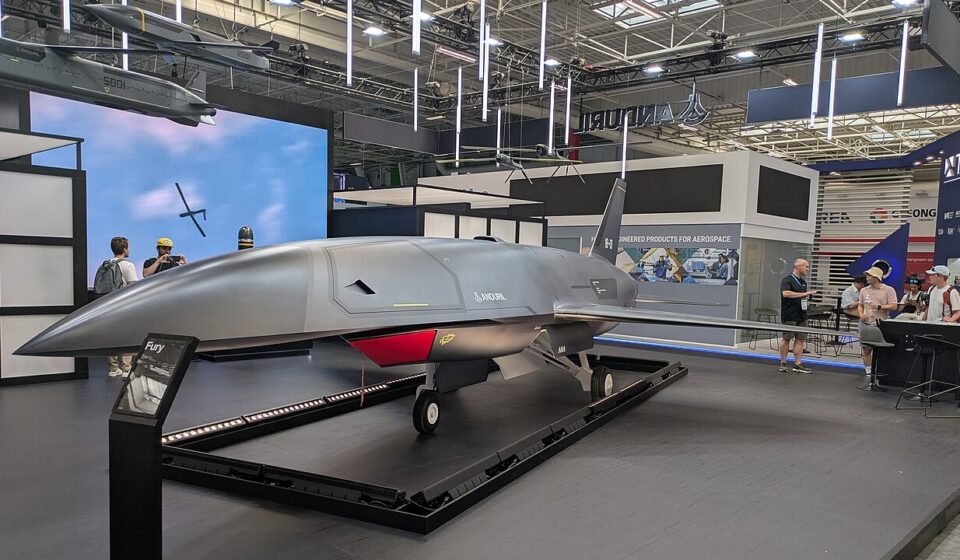


Anduril’s YFQ-44 “Fury” drone on display at the Salon du Bourget airshow in Paris in June 2025. The drone, now known as the FQ-44, is set to enter regular production. (Wikimedia Commons/Artvill)
Anduril and General Atomics Just Officially Won the Air Force’s Drone Contract
It appears that the Air Force will begin to use both the FQ-42 and FQ-44 drones, rather than choosing one over the other.
The United States Air Force recently announced that both companies competing for the Collaborative Combat Aircraft (CCA) contract will see their respective platforms move to the production stage. Two years ago, Anduril Industries and General Atomics Aeronautical Systems (GA-ASI) were selected to develop prototypes, with the firms’ unmanned aerial systems (UAS) being chosen over competing offerings from Boeing, Lockheed Martin, and Northrop Grumman.
In March 2025, Anduril’s “Fury” received the designation YFQ-44, and GA-ASI’s XQ-67A, part of its “Gambit” series of drones, was designated the YFQ-42 Dark Merlin. Both platforms underwent ground and initial flight testing last year, and each will now advance to the initial production phase under the CCA’s Increment 1.
With their entry into production, the “Y” designation, indicating a prototype aircraft, will be dropped from the names of both drones, leaving them as the FQ-42 and FQ-44.
Although the United States Air Force previously announced that it could field upwards of 1,000 combat-capable CCA drones, it has not confirmed how many of each of the FQ-42 or YFQ-44 systems will ultimately be produced. The contract awards were issued four months ahead of schedule, highlighting that both prototypes have met the US Air Force’s rigorous mission requirements.
“By moving fast from competitive selection into full-scale manufacturing, we position ourselves to field highly credible and combat-ready semi-autonomous systems to stay ahead of the pacing challenge,” Secretary of the Air Force Troy Meink said in the Air Force’s media statement. “These contracts reaffirm our confidence in the strategic path forward for the program to procure over 150 combat capable CCA by the end of the decade.”
Both companies acknowledged the awards and highlighted the capabilities and attributes of their respective aircraft.
“Under the contract, Anduril will deliver an initial set of production FQ-44 semi-autonomous fighter aircraft to support continued testing, validation, and, ultimately, operational fielding,” Anduril wrote in its own statement following the contract award. “The contract also establishes a structure for the Air Force to buy additional lots of production FQ-44 aircraft across the next several years, providing a clear path for the Air Force to rapidly and affordably expand fighter capacity.”
The aerospace startup also noted that this marked “the first time that a new company has won a fighter aircraft program since the 1970s,” stressing the Fury drone’s unlikely journey from a “bar napkin” to full-scale production.
A similar sentiment regarding the quick development cycle was shared by General Atomics.
“Moving to production on FQ-42A is the result of an extraordinary partnership and many years of investments between General Atomics and the US Air Force,” said GA-ASI President David R. Alexander. “We’ve been preparing for this order, and manufacturing is already well underway.”
The Air Force Is Getting New Software, Too—with a Twist
The production contracts were just two of several awards issued by the Department of the Air Force to support the CCA this week. In addition to the Increment 1 air vehicles, the DAF is supporting the development of mission autonomy software, an effort it described as “software sold separately,” that can also be easily updated as new features and capabilities are developed.
That was meant to ensure that there won’t be proprietary software driving the platforms, and further innovation, which the DAF said breaks the traditional procurement model.
CCA will also build on decades of semi-autonomous flight development, where the unmanned aircraft will serve as loyal wingmen that can act as force multipliers to extend the awareness, combat reach and even the survivability of manned US Air Force aircraft.
“Collaborative Combat Aircraft change how we project power and generate mass in highly contested environments,” said Air Force Chief of Staff Gen. Ken Wilsbach. “Delivering this capability to our warfighters faster ensures our forces maintain the tactical edge required to deter and, if necessary, defeat any adversary.”
The Air Force awarded mission autonomy contracts to six companies, which will work to develop the software to support the CCA. Those firms were Anduril, General Atomics, Lockheed Martin, Northrop Grumman, RTX (Raytheon) Collins Aerospace, and Shield AI.
Anduril, RTX Collins Aerospace and Shield AI have also received production option contracts to accelerate the delivery of the “critical mission autonomy software.” The competitive awards are meant to deliver the software capability faster. After six months, the DAF will evaluate the process of each vendor, which will then be followed by a second competitive award.
“Mission autonomy is the cornerstone of the CCA concept, and leveraging a competitive, multi-vendor environment ensures we capture the latest technology,” Meink said. “This approach guarantees our Airmen are equipped with state-of-the-art capabilities today but keeps the door open for the breakthroughs necessary to maintain air superiority.”
The CCA is being developed to support existing fifth-generation and future sixth-generation manned fighters and other aircraft, including the US Air Force Northrop Grumman B-21 Raider, where autonomous drones could fly alongside the bomber to expand sensor reach and act as defensive escorts.
About the Author: Peter Suciu
Peter Suciu has contributed to dozens of newspapers, magazines and websites over a 30-year career in journalism. He regularly writes about military hardware, firearms history, cybersecurity, politics, and international affairs. Peter is also a contributing writer for Forbes and Clearance Jobs. He is based in Michigan. You can follow him on Twitter: @PeterSuciu. You can email the author: Editor@nationalinterest.org.
The post Anduril and General Atomics Just Officially Won the Air Force’s Drone Contract appeared first on The National Interest.