
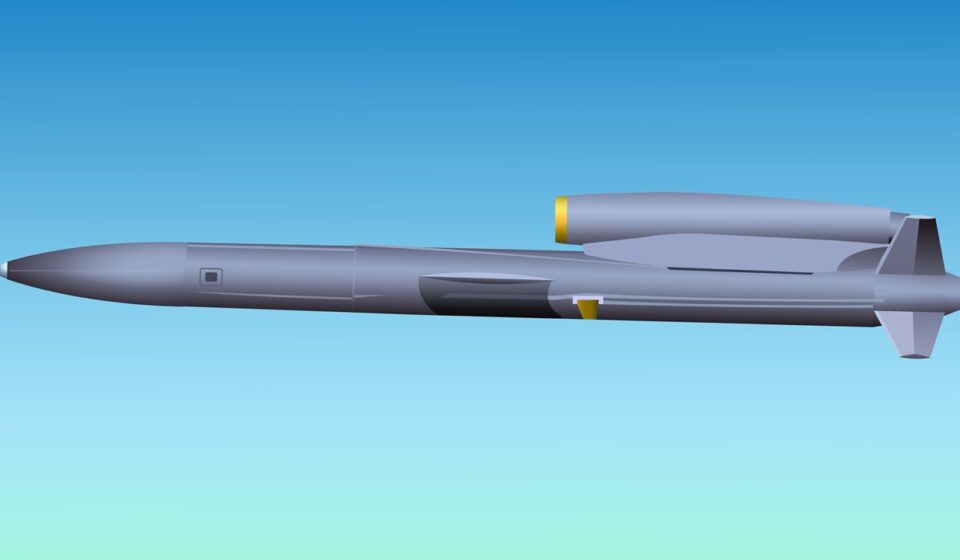


Concept illustration of a Ukrainian “Flamingo” missile in flight. Ukraine’s Flamingo missiles are far cheaper than American cruise missiles and have certain advantages over them, including longer ranges. (Shutterstock/Razdas2008)
Europe Wants to Buy Missiles from Ukraine. Here’s Why It Might Happen.
Ukraine has perfected the art of air warfare on the cheap—an appealing prospect to European nations struggling to quickly rearm.
For much of the war, Ukraine depended on Western missiles to strike Russian targets. Now the relationship is beginning to reverse.
European defense giants MBDA and Diehl are pursuing partnerships with Ukrainian missile manufacturers, potentially bringing combat-proven Ukrainian cruise missile technology into NATO arsenals. This development reflects both Ukraine’s rapid wartime innovation and Europe’s growing realization that it lacks sufficient indigenous long-range strike capabilities.
Why Is Europe So Interested in Ukrainian Missiles?
Europe is currently grappling with a severe long-range strike deficiency. While Russia fields large numbers of land-attack missiles and long-range strike systems, European NATO members are short on such systems, relying instead on American systems. And recent tensions with Washington have reinforced the idea that Europe should not be depending so heavily on US-supplied weaponry.
However, the fix isn’t so easy. New European missile programs are still years away; many won’t enter service until the 2030s. Europe needs a solution now. It can find one in Ukraine, which has used advanced missiles against Russia to great effect.
Ukraine’s most famous missile, the Neptune, began as an anti-ship missile derived from the Soviet-era Kh-35. It became famous, early in the war, after helping to sink Russia’s Black Sea flagship, the cruiser Moskva, in 2022. Since then, Ukraine has steadily expanded the design. Where the original anti-ship version had a 190-mile range, the subsequent land-attack Neptune had a 225-mile range, and the newer long-range Neptune has an impressive 620-mile range—three times longer than the original.
Now, MBDA has signed an agreement with Ukrainian firm Luch focused on future Neptune development. The goal is to expand deep-strike capability while incorporating European industrial expertise.
Another missile, Ukraine’s jury-rigged Flamingo, may be attracting even more attention. Germany’s Diehl Defense is pursuing production cooperation on the missile, originally developed from a training drone. The Flamingo’s reported numbers are impressive; its range is allegedly 1,864 miles, nearly double that of the US-made Tomahawk, with a similar warhead capacity. Launched from rails using a trailer system, the Flamingo is powered by a Ukrainian built AI-25 turbofan engine.
For Ukraine, Keeping Costs Down Is Paramount
Ukraine has become adept at wartime economics, designing weapons differently than many Western defense firms. In Ukraine, design priorities include mass production, lower cost, rapid development, and battlefield adaptability. The West, recognizing the importance of scale and depth, seeing the way that Iranian systems have exhausted US stores of high-end missiles, are seeing the value in the Ukrainian production methods.
On the flip side, compared to far more cutting-edge US projectiles, the Ukrainian missiles are not especially sophisticated. Neither the Neptune nor the Flamingo is an exquisite weapon. Both weapons lack stealth, fly at subsonic speeds, and have limited signature reduction features. This has given them limited effectiveness inside Russia, which has modern air defenses around nearly all targets of strategic value. However, Ukraine has compensated through tactics, namely, mass missile launches, drone swarms, decoys, and saturation attacks. Rather than develop sophisticated weapons that can penetrate air defense systems individually, Ukraine has opted to overwhelm defenses with mass—a likely portent for the future of air warfare.
The new partnership shows that Europe is confronting a capability gap. Long-range strike remains one of NATO’s weakest conventional areas. American systems cannot always be assumed available. And indigenous European programs remain years from development. Ukraine offers a shortcut—helping it to evolve from a security consumer into a security producer in the process.
About the Author: Harrison Kass
Harrison Kass is a writer and attorney focused on national security, technology, and political culture. His work has appeared in Tablet, City Journal, The Hill, The Spectator, and The Cipher Brief. He holds a JD from the University of Oregon and a master’s in Global & Joint Program Studies from NYU. More at harrisonkass.com.
The post Europe Wants to Buy Missiles from Ukraine. Here’s Why It Might Happen. appeared first on The National Interest.