
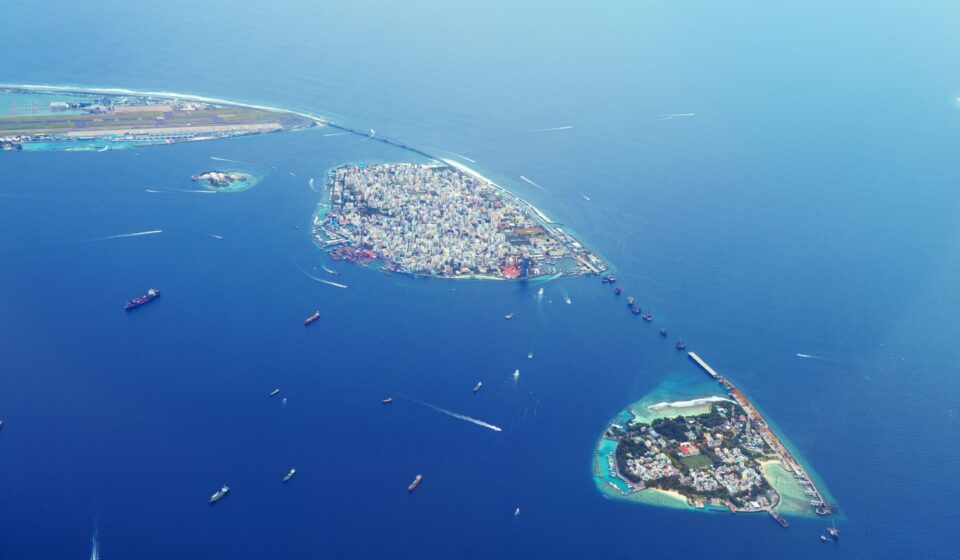


Aerial view of Male harbor in the Maldives. The Maldives is testing an electric hydrofoil network that could reshape maritime transportation for island nations and coastal cities. (ShutterstockIgor Link)
The Future of Maritime Transport Is Being Tested in the Maldives
The Maldives is testing an electric hydrofoil network that could reshape maritime transportation for island nations and coastal cities.
The Strait of Hormuz may soon reopen, but maritime transport as we know it is about to change.
As the world waits with bated breath to see whether the current peace in the Middle East holds, the recent Iran war was above all a reminder of the outsized role that fossil fuels play in the global energy supply chain. At a time when talk of renewables and net zero is increasingly unfashionable, the hijacking of Hormuz should give us pause for thought.
The Maldives Is Becoming a Laboratory for Sustainable Maritime Transport
One country for whom net zero still matters plenty is the Maldives. This remote tourism hotspot in South Asia is made up of more than 1,192 coral islands. Roughly 200 of these islands are inhabited and another 140 or so are resorts. The country has the lowest average elevation of any country in the world. In other words, Maldivians have reason to be more worried about rising sea levels than most. As a result, the archipelagic nation has become a world leader in innovative solutions to climate change problems, from land reclamation to coastal protection.
The latest innovation, announced two weeks ago, is being billed as the first standardized inter-island transportation network of its kind in the world. The so-called Navier Network will be a software-driven sustainable maritime corridor designed to connect airports, resorts, private villas, and local islands through a fleet of electric hydrofoil vessels. This $100 million dollar project is the result of a partnership between Bay Area–based maritime technology company Navier, and JIH Global Investment, a Dubai-based investment and development group.
Of course, not only is the Maldives climate-vulnerable, but like many island states it is also dependent on imported fuel. The World Bank has noted that the Maldives’ reliance on imported diesel for power generation contributes to high electricity costs for its citizens. As such the country has targeted net zero by 2030 with international support.
“The Maldives has always been at the frontier of luxury tourism, but as an island nation on the frontlines of climate change, we also have an opportunity to help define what the future of waterborne transportation looks like,” said Mohamed Ali Janah, Chairman of JIH Global Investment, who is also an advisor to the President of the Maldives on trade and investment. He added that “With Navier, we see the potential to build not only a cleaner, more seamless network connecting airports, resorts, villas, and islands, but a scalable blueprint for sustainable maritime transportation, extending beyond the Maldives to island nations and coastal cities around the world.”
Electric Hydrofoil Vessels Could Transform Island Transportation
Logistics for small islands have always been tricky. Consider the United Kingdom where everything from the world’s shortest commercial flight to the only commercial hovercraft service in the world help to connect a country of 188 inhabited islands out of 4,000 in total.
The Maldives is an important test case for a technology that could have other applications. The Monetary Authority database shows 2.25 million tourist arrivals in 2025, up 9.8 percent from the previous year. Unlike many green transport pilots, this one is not being tested in a marginal market. It is being deployed in a country where nearly every tourist journey requires a boat or seaplane connection.
“Scalable” is the key word here. While hydrofoil technology—which lifts boats out of the water to reduce energy consumption, operating costs, noise, and emissions—is not new, widespread adoption has been hampered by how complex and expensive the boats are to build and maintain. The Maldives will serve as the blueprint for scaling hydrofoil vessels, first across island nations like the Maldives, but then onto premium coastal markets in the United States as well, from New York and San Francisco Bay to Miami, Nantucket, and the Hamptons. Navier even claims its vessels have significantly lower operating costs than traditional gas boats, thanks to standardized operations and software-driven fleet management that improve efficiency while maintaining profitability.
“The Maldives is one of the most important maritime transportation markets in the world,” says Sampriti Bhattacharyya, founder and CEO of Navier. He went on to say that, “Nearly every guest, every worker, every resort, and every island depends on boats or seaplanes. That makes the Maldives the perfect place to prove that maritime transportation can be cleaner, quieter, standardized, software-driven, and dramatically better for the guest experience. We are not just deploying boats. We are building the first sustainable luxury transportation network on water.”
Why Maritime Transportation Networks Matter More Than Individual Boats
The key part here is “network” A single electric hydrofoil is a fun afternoon. A coordinated fleet running along standardized routes at the whims of a digital dispatching, begins to look like infrastructure that island nations desperately need. At the United Nations Small Islands State Summit which the author attended in 2023, transportation needs were a frequent topic of discussion.
An initial fleet of five Navier vessels will be rolled out this year, with 95 additional vessels over the next three years. It will be the first full-network deployment of Navier’s fleet and software platform, which aims to eventually replace the Maldives’ current fragmented system of some 3,000 gas powered boats which served more than 2.2 million tourists in 2025.
What the Maldives Means for the Future of Maritime Transportation
With a national goal of reaching net zero by 2030, marine transportation remains a key sector for modernization for the Maldives. This JIH-Navier Maldives partnership has implications for the future of energy—what kind of energy we use, how we will use it and how it will shape infrastructure, transport and tourism.
None of this means electric hydrofoils are going to replace supertankers. The designers of future Suezmax or Lombokmax container ships are safe. The vessels moving through the Strait of Hormuz belong to a different maritime universe: crude carriers, liquefied natural gas (LNG) tankers, container ships, and, of course, naval escorts.
However, new innovations in hydrofoil transportation mark a solid win. While the vessels themselves leave little wake, the waves they are making in the Maldives will have ramifications elsewhere.
About the Author: Joseph Hammond
Joseph Hammond is a journalist and former Fulbright public policy fellow with the government of Malawi. He has reported from four continents, with bylines in Newsweek, The Washington Post, Forbes.com, and The National Interest. Hammond has been a recipient of fellowships from the National Endowment for Democracy, the Atlantic Council, the Heinrich Boll Stiftung North America Foundation, and the Policy Center for the New South’s Atlantic Dialogue.
The post The Future of Maritime Transport Is Being Tested in the Maldives appeared first on The National Interest.