
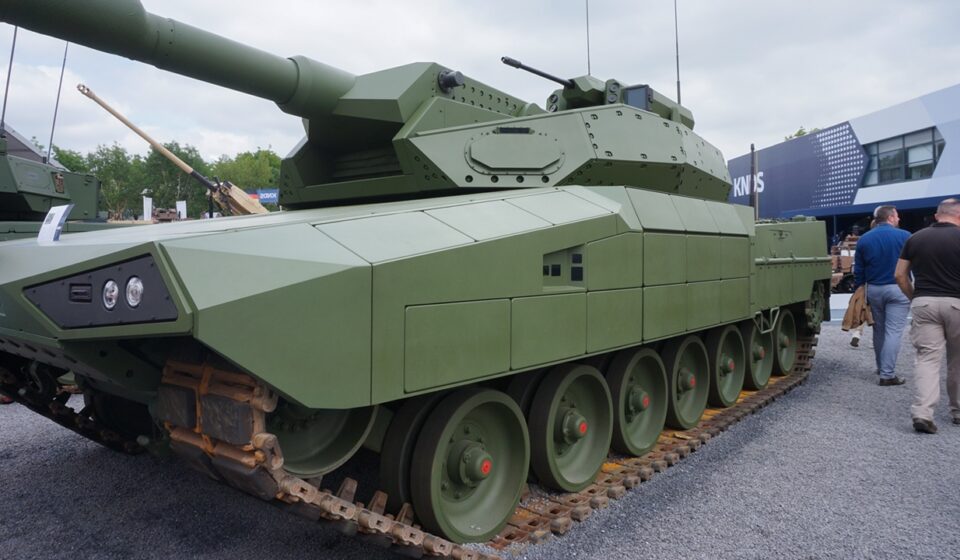


A new Leopard 2 tank on display at a defense expo in Paris in June 2024. The Leopard is very similar to the upcoming CAPINT tank, although the CAPINT is expected to feature a different turret. (Shutterstock/Spech)
The One Reason the ‘CAPINT’ Tank Is Better Than Its MGCS Successor
Tanks are more useful when they actually exist—and the CAPINT is expected to beat its eventual successor to the battlefield by years, if not decades.
Franco-German defense contractor KNDS made waves last week when it revealed a new main battle tank, the CAPINT, to replace the French Army’s aging Leclerc tanks.
The tank’s temporary nature is almost built into its design. Indeed, the tank’s name—CAPacité INTermédiaire, or “intermediary capability” in French—is a nod to its expected phase-out as the more capable Main Ground Combat System (MGCS) main battle tank comes online. Yet amid the latter vehicle’s struggles, the CAPINT is far closer to actual production than the MGCS is—and a tank on the battlefield now is far more valuable than one entering service in a decade or two.
The CAPINT Tank Is Nearly Here, and the MGCS Isn’t
The French Army could get a new tank in the near future. During the Eurostat defense expo in Paris, KNDS revealed that the CAPINT tank would be offered to the French military in the near future. The European defense company did not specify exactly when the CAPINT would come online—but it is certain to be long before the MGCS will, as the latter tank is not expected to be introduced until the 2040s.
Development of the CAPINT is centered around five principles: firepower, protection, counter-drone capabilities, mobility, and digitalization. The new tank will be a multiplatform system around a central platform, with open architecture and a digital core that will make future upgrades easier. In terms of the superstructure, it will use the chassis of the Leopard 2A8 and sport a 120mm smoothbore autoloaded main gun.
“These systems embody the unique value proposition of KNDS designing and orchestrating system-of-systems capabilities, connecting platforms, sensors, effectors and digital solutions to enhance battlefield effectiveness,” Jean-Paul Alary, CEO of KNDS, said in a company media release.
KNDS is offering the CAPINT as an interim replacement for the French Army’s aging Leclerc fleet. Starting in 1992, the French military has purchased approximately 400 Leclerc tanks, with about 200 in active service and around 185 in storage. The Leclerc is a third-generation main battle tank.
“We are bringing together French and German capabilities within single, fully integrated solutions designed, developed and supported by one company. It demonstrates our ability to transform European industrial cooperation into concrete capabilities for our customers,” Alary said. Although the tank is not expected to enter service with the Bundeswehr, given its operation of the highly effective Leopard 2, German manufacturers will likely benefit from the CAPINT’s construction.
In the Era of Drones, Tank Warfare Is Complicated
Although many pundits opined that tank warfare was a thing of the past, the war in Ukraine quickly cleared up any such notions.
To be sure, tanks do not have the same role they did a few decades ago. No one expects another huge tank clash like the one between the German and Soviet forces in Prokhorovka during the Battle of Kursk in 1943, which involved nearly 1,000 main battle tanks and assault guns on both sides.
Although such days of massed armor warfare are gone, tanks do play an important role in offensive and defensive operations. Both the Ukrainian and Russian forces are using tanks profusely on a daily basis to advance on the line or defend an urban position. Armor encounters are not that common, but they do happen.
This reality has pushed militaries around the world to revise their tank warfare doctrines and come up with new main battle tanks that not only survive in today’s drone-ridden battlefields but also excel against any ground threat.
About the Author: Stavros Atlamazoglou
Stavros Atlamazoglouis a seasoned defense journalist specializing in special operationsand a Hellenic Army veteran (national service with the 575th Marine Battalion and Army HQ). He holds a BA from the Johns Hopkins University, an MA from the Johns Hopkins’ School of Advanced International Studies (SAIS), and a JD from Boston College Law School. His work has been featured in Business Insider, Sandboxx, and SOFREP.
The post The One Reason the ‘CAPINT’ Tank Is Better Than Its MGCS Successor appeared first on The National Interest.