
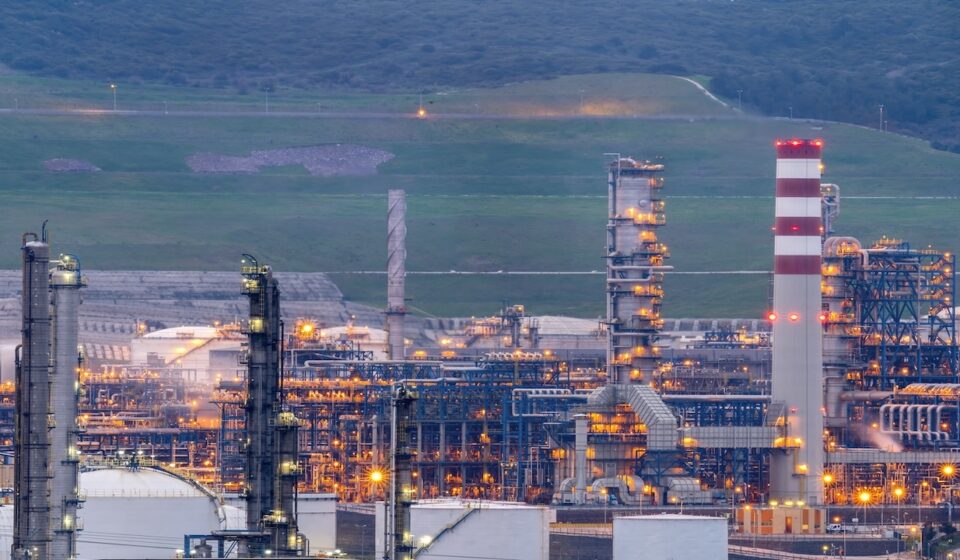


Aerial view of an oil refinery plant in Aliaga, Izmir, Turkey, March 2022. As Europe reduces its reliance on Russian gas, Turkey is using LNG, infrastructure, and geography to strengthen its role in regional energy security. (Shutterstock/Merih Salmaz)
Turkey’s Bid to Become Europe’s Energy Hub
As Europe reduces its reliance on Russian gas, Turkey is using LNG, infrastructure, and geography to strengthen its role in regional energy security.
Europe’s effort to reduce its dependence on Russian gas is reshaping the continent’s energy map. But it is also elevating a country that sits at the crossroads of Europe, Asia, and the Middle East: Turkey.
For decades, Europe’s energy security strategy was built around pipelines. Russian gas flowed westward through fixed networks that created economic interdependence and geopolitical leverage. Projects such as Nord Stream became symbols of this model, linking Russia directly to European consumers while reinforcing concerns about strategic dependence on Moscow.
Russia’s invasion of Ukraine shattered many of those assumptions. European governments moved rapidly to diversify supply, secure alternative sources of gas, and reduce exposure to Russian energy. Liquefied natural gas (LNG) became a central pillar of that strategy.
The rise of LNG represents more than a change in how gas is transported. It is changing the geopolitical logic of energy itself. Pipeline networks created fixed relationships between producers, transit states, and consumers. LNG introduces flexibility. Cargoes can be redirected, suppliers diversified, and new routes established with far greater ease. As a result, influence increasingly belongs not only to those who produce energy, but also to those who control the infrastructure through which it flows.
Turkey’s Opportunity in Europe’s New Energy Map
This shift is creating new strategic winners. Turkey hopes to be one of them. Much attention has focused on Germany’s new LNG terminals, Poland’s efforts to expand import capacity, and Greece’s ambition to become a gateway for southeastern Europe. Yet a less discussed transformation is taking place further south. Turkey is positioning itself not merely as an energy transit state, but as a regional energy hub capable of shaping how gas moves between producers and consumers across Eurasia.
The distinction matters.
A transit country simply hosts infrastructure. An energy hub shapes flows, attracts investment, and gains strategic influence. Ankara increasingly appears determined to become the latter.
Turkey’s advantages begin with geography. Few countries occupy a more strategically valuable position. To its east lie the energy producers of the Caucasus, Central Asia, and the Middle East. To its west sits Europe, one of the world’s largest energy markets. To its south lies the Eastern Mediterranean, a region increasingly shaped by energy competition and connectivity projects.
For years, Turkey’s energy role was largely associated with pipelines. The Trans Anatolian Natural Gas Pipeline (TANAP) established Turkey as a critical corridor connecting Caspian gas with European consumers, while TurkStream reinforced its role in transporting Russian gas into southeastern Europe.
How LNG Is Reshaping European Energy Security
Yet the global LNG revolution is changing the rules. Unlike pipelines, LNG offers flexibility. Cargoes can be sourced from multiple suppliers, redirected according to market conditions, and delivered wherever demand is strongest. In an era defined by energy security concerns, flexibility has become a strategic asset.
Turkey recognized this shift earlier than many European states. Over the past decade, Ankara has invested heavily in LNG terminals, floating storage and regasification units (FSRUs), underground storage facilities, and transmission infrastructure.
The scale of that investment is striking. Turkey’s regasification capacity has increased from roughly 37 million cubic meters per day before 2016 to around 150 million cubic meters per day by 2025. This expansion has transformed the country’s ability to receive gas from global markets rather than relying predominantly on pipeline imports.
The numbers increasingly reflect that shift. Turkey imported approximately 12.38 million tonnes of LNG in 2025, compared with 9.17 million tonnes in 2024, representing an annual growth of around 35 percent. At the same time, Ankara has expanded its supplier base beyond traditional partners, increasing imports from the United States while securing cargoes from emerging producers including Mozambique, Senegal, Mauritania, and Equatorial Guinea.
Turkey’s LNG Infrastructure Expansion and Natural Gas Diversification
This diversification is not simply an energy policy. It is a geopolitical strategy. Countries dependent on a small number of suppliers are vulnerable to disruptions, price shocks, and political pressure. Countries able to source energy from multiple regions possess greater flexibility and resilience. Turkey’s LNG expansion has significantly strengthened its ability to navigate an increasingly uncertain global energy environment.
Infrastructure alone, however, does not explain Ankara’s ambitions. Turkey is also seeking to lock in long-term access to global LNG supplies. In 2025, state energy company BOTAŞ signed a 20-year LNG agreement with Mercuria covering approximately four billion cubic meters annually from US export facilities. The agreement reflects a broader objective: securing diversified supply while strengthening Turkey’s position as a regional trading and distribution center.
Such deals carry geopolitical significance. They deepen energy ties between Turkey and the United States while reinforcing Ankara’s role as a potential bridge between global LNG markets and European consumers.
Turkey’s energy strategy also intersects with a broader transformation in transatlantic energy relations. Since Russia’s invasion of Ukraine, the United States has emerged as Europe’s most important LNG supplier, fundamentally reshaping the continent’s energy landscape. American LNG exports have helped replace significant volumes of Russian gas while strengthening Washington’s role in European energy security.
Turkey’s growing LNG infrastructure reinforces this trend. By expanding its capacity to receive, store, and redistribute LNG, Ankara is helping create new pathways through which global energy supplies, including those originating in the United States, can reach European markets. In this sense, Turkey’s energy ambitions are becoming part of a wider effort to build a more resilient and diversified European energy system.
Turkey’s Black Sea Gas Production and Energy Security Goals
At the same time, Turkey is pursuing a second pillar of its energy strategy: increasing domestic production. The Sakarya gas field in the Black Sea has become one of the country’s most strategically important energy projects. Production reached approximately 9.5 to 10.5 million cubic meters per day in 2025, with government plans to exceed 20 million cubic meters per day as additional infrastructure comes online.
Ankara has also continued to invest in offshore exploration. In 2025, Turkish authorities announced a new natural gas discovery in the Black Sea estimated at 75 billion cubic meters and valued at roughly $30 billion.
These discoveries are unlikely to transform Turkey into a major gas exporter. Nevertheless, they strengthen domestic energy security, reduce import dependence, and support Ankara’s broader ambition to become an influential energy hub.
Why Energy Infrastructure Creates Geopolitical Influence
Taken together, LNG expansion and domestic production represent a dual strategy that few European countries can match. Turkey is simultaneously increasing its ability to import gas from global markets while expanding its indigenous supply. This combination provides a level of flexibility that is becoming increasingly valuable in a fragmented energy landscape.
The implications extend beyond Turkey itself.
Historically, energy relationships have often translated into political influence. Russia demonstrated this through its pipeline network. Norway has long exercised strategic importance through its role as a reliable supplier. Gulf states have leveraged energy exports to deepen diplomatic partnerships. Turkey appears to recognize that infrastructure itself can be a source of geopolitical power.
The consequences are particularly significant in the Eastern Mediterranean. For more than a decade, regional energy debates have centered on maritime disputes, offshore gas discoveries, and competing export routes. Greece, Cyprus, Israel, and Turkey have all sought to secure positions within the region’s evolving energy architecture.
The LNG era may alter those calculations. Rather than relying exclusively on large and politically contentious pipeline projects, European consumers increasingly value flexibility, storage capacity, and diversified supply chains. This creates opportunities for countries capable of integrating multiple energy routes and transportation systems. Turkey’s combination of LNG facilities, pipeline connections, Black Sea production, and strategic geography provides a unique advantage.
That does not mean Ankara’s ambitions will be realized without obstacles. Political tensions with the European Union persist. Relations with Greece remain complicated despite recent diplomatic improvements. Investors continue to seek greater regulatory predictability and market transparency. Regional instability also creates uncertainty.
Turkey’s Role in Europe’s Post-Russia Energy Future
Yet the broader trajectory is becoming increasingly difficult to ignore.
Europe’s search for energy security is producing new centers of influence. The countries that host critical infrastructure are becoming more important not only economically but strategically. LNG terminals, storage facilities, and interconnectors are no longer merely commercial assets. They are instruments of geopolitical power.
For Turkey, this presents a historic opportunity. For decades, Ankara’s geopolitical significance was primarily derived from its location between regions. Today, it is seeking to convert that location into influence through infrastructure, connectivity, and energy diplomacy.
Whether Turkey ultimately becomes Europe’s leading energy hub remains uncertain. But one reality is already clear: as Europe redraws its energy map after Russia’s invasion of Ukraine, Turkey is positioning itself at the center of the new one.
The future of European energy security may not be determined solely in Brussels, Berlin or Moscow. Increasingly, it may also be shaped in Ankara.
About the Author: Mergim Ozdamar
Mergim Ozdamar is a London-based writer whose work explores current affairs, culture, power, and belonging. She writes about the forces that shape societies and identities, with particular interests in geopolitics, diplomacy, defense, human rights, and international affairs. Her writing has appeared in National Geographic, The i Paper, Serious Eats, and TRT World, with a particular focus on Turkey, Europe, and the wider Mediterranean region. She will begin working toward a master’s in international affairs at King’s College London this year.
The post Turkey’s Bid to Become Europe’s Energy Hub appeared first on The National Interest.